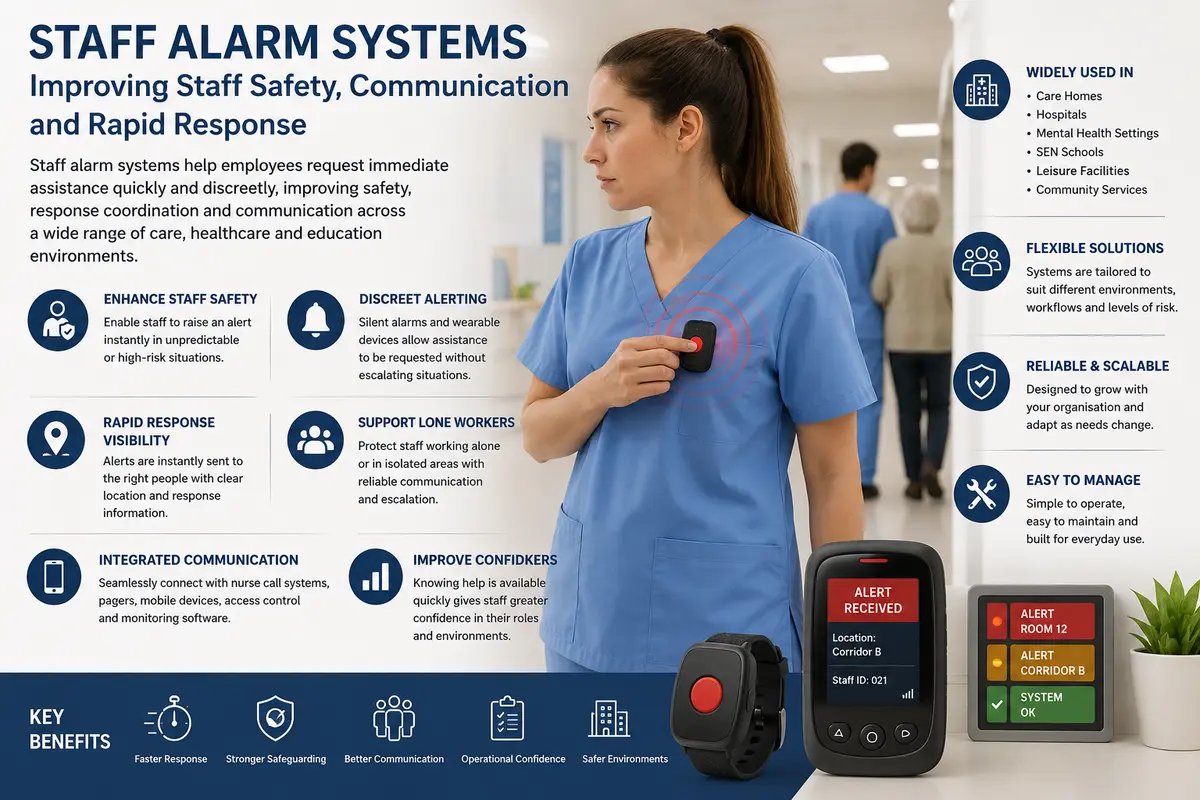
In many healthcare, education, and care environments, staff alarm systems are used to improve communication during situations where immediate assistance may be required, but fixed call infrastructure is not always practical.
Unlike traditional nurse call systems, which are primarily designed around resident or patient assistance requests, staff alarm systems focus more directly on employee safety, response coordination, and rapid communication during unpredictable situations.
The environments themselves often determine how these systems are used. In some settings, alarms may support lone workers moving between isolated areas of a building. In others, they may be used within mental health environments, SEN schools, hospitals, leisure facilities, or care settings where staff occasionally require immediate support from nearby colleagues.
The objective is not simply to generate an alert. It is to ensure that staff can request assistance quickly and discreetly while maintaining clear visibility of responses across the wider environment.
Staff Safety Requirements Vary Between Environments
Different working environments create different operational risks.
In a care home, staff may occasionally need urgent assistance while supporting residents with mobility difficulties, behavioural distress, or complex care requirements. In hospitals, alarms may support teams working within busy departments, isolated treatment areas, or unpredictable clinical situations. SEN environments may require staff communication systems that allow discreet assistance requests without unnecessarily escalating situations around pupils.
Because of this, staff alarm systems are rarely identical across every environment.
Some organisations prioritise:
- Discreet wearable alarms
- Mobile staff communication
- Fixed panic points
- Lone worker protection
- Escalation procedures
- Location visibility
- Integrated response management
while others require relatively simple staff-assistance functionality in smaller buildings.
The operational environment typically determines which features genuinely improve staff safety day to day.
In specialist education environments, many organisations also review staff call systems for SEN schools and colleges differently from standard healthcare environments.
Discreet Alerting Is Often Operationally Important
In many environments, staff may need assistance without escalating attention within the immediate area.
This is particularly relevant in:
- Mental health settings
- Dementia care environments
- SEN schools
- Behavioural support environments
- Public-facing healthcare areas
A highly visible or audible emergency response can sometimes unnecessarily increase distress or agitation, depending on the situation.
For that reason, many staff alarm systems use discreet communication methods that allow alerts to be raised silently while still maintaining rapid visibility elsewhere within the building.
This may involve:
- Wearable alarm devices
- Mobile alerts
- Pager notifications
- Handheld devices
- Silent escalation procedures
- Location-based alert routing
The system needs to support rapid response without creating additional operational difficulty around the incident itself.
Response Visibility Matters As Much As The Alert Itself
A staff alarm is only effective if colleagues can identify and respond to it quickly within the operational realities of the environment.
In smaller buildings, this may rely on simple local visibility or staff awareness. In larger or more complex environments, systems often need to support:
- Multi-area alerting
- Mobile staff notification
- Escalation routing
- Location identification
- Repeated alerting if unanswered
The challenge is not simply generating a notification. It is ensuring the alert reaches the right people quickly enough to support the situation effectively.
This becomes increasingly important where:
- Staff work across multiple floors
- Teams move continuously throughout the building
- Lone working occurs
- Environments remain operational overnight
- Staffing levels fluctuate across different areas
Under those conditions, response visibility becomes an operational issue rather than purely a technical one.
In healthcare environments, this operational visibility often overlaps closely with nurse call response management and wider safeguarding communication procedures.
Lone Working Creates Different Communication Pressures
Many organisations now use staff alarm systems specifically to support lone workers or employees working within isolated areas.
In healthcare and care environments, this may involve:
- Community support staff
- Maintenance personnel
- Mobile carers
- Overnight teams
- Staff covering quieter areas of large buildings
- Employees opening or closing facilities alone
In these situations, immediate physical assistance may not always be nearby. The communication system, therefore, needs to support rapid escalation and provide clear visibility into where support is required.
The goal is not to replace staffing procedures or operational safeguarding measures. It is to reduce the risk of situations developing without colleagues being aware that assistance is needed.
Staff Confidence Is Often Overlooked
One of the less visible benefits of staff alarm systems is the operational reassurance they provide.
In unpredictable environments, employees often work more confidently when they know they can request assistance quickly if circumstances change unexpectedly. This does not mean incidents occur constantly. In many environments, alarm devices may rarely be activated. Their value often lies more in maintaining confidence in communication across the workforce.
That can be particularly important in:
- High-dependency care environments
- Behavioural support settings
- Overnight staffing situations
- Isolated working areas
- Public-facing roles
The system becomes part of the wider operational structure that supports staff communication and safeguarding, rather than existing solely for emergency activation.
Integration With A Wider Communication Infrastructure
Staff alarm systems are often integrated into broader communication and safeguarding infrastructure rather than operating independently.
Depending on the environment, systems may connect with:
- Nurse call infrastructure
- Corridor indicators
- Pagers
- Mobile communication devices
- Annunciator panels
- Access control systems
- Monitoring software
- Emergency alert systems
This layered approach allows organisations to manage alerts more consistently across different operational areas without relying on isolated standalone devices.
In larger healthcare environments, integration can be particularly important when multiple departments, teams, or response pathways operate simultaneously across the site.
Operational Suitability Matters More Than Feature Quantity
As with nurse call infrastructure, the most effective staff alarm systems are not necessarily the most complicated.
In some environments, a simple, highly reliable alert process may be operationally stronger than a heavily layered system that staff find difficult to use consistently under pressure.
The system needs to fit naturally into:
- Staffing workflows
- Building layouts
- Communication procedures
- Safeguarding arrangements
- Response expectations
If the technology becomes overly complex to operate, response efficiency can actually weaken despite the system having more technical capability on paper.
That balance between functionality and usability is usually one of the most important aspects of successful system design.
The Environment Itself Usually Determines The Right Solution
A hospital department, SEN school, leisure facility, care home, and mental health environment all place different demands on staff communication systems.
Because of this, staff alarm infrastructure is usually most effective when it is designed around the operational behaviour of the environment itself rather than applied using a standardised template approach.
That may involve prioritising:
- Discreet communication
- Rapid escalation
- Mobile visibility
- Lone worker support
- Staff location awareness
- Integration with existing infrastructure
- Simplified response pathways
depending on how the environment functions day to day.
The strongest systems are usually the ones that support communication naturally within the building’s operational realities, rather than simply adding more devices or features unnecessarily.