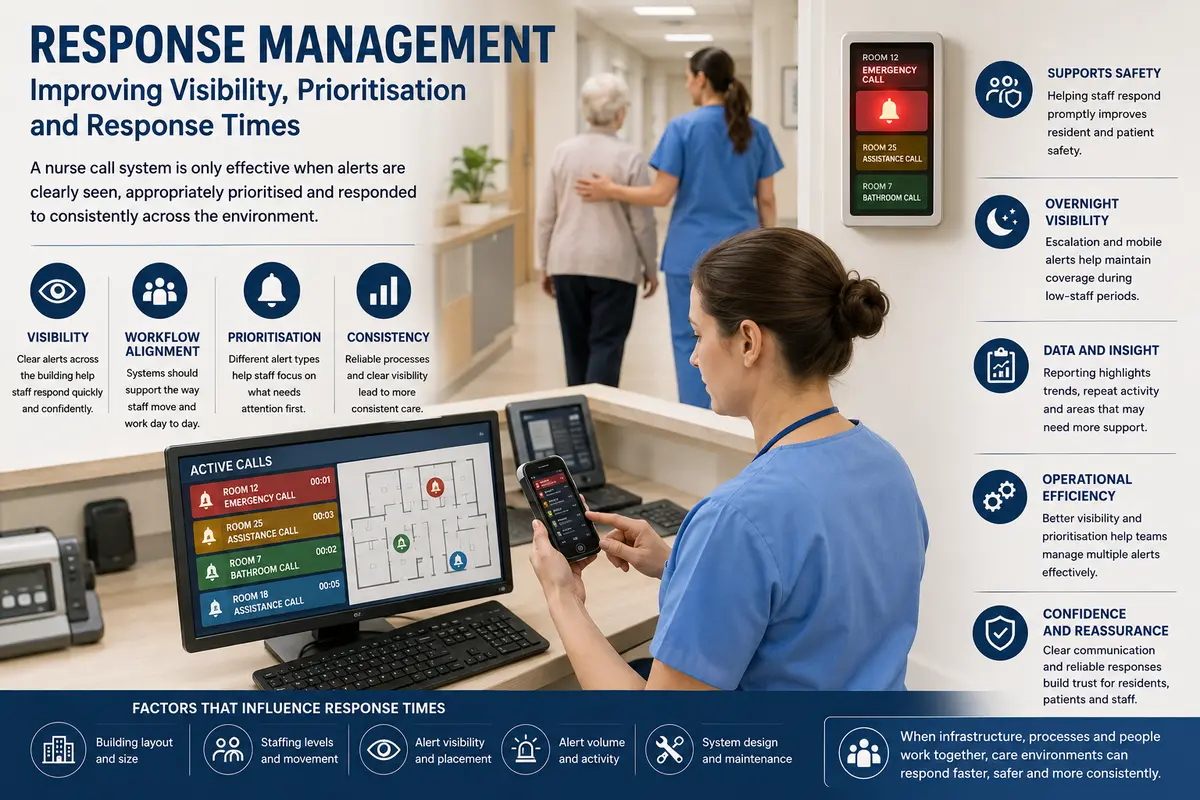
In most care environments, response times are influenced as much by visibility, staffing workflows, and operational organisation as they are by the nurse call infrastructure itself. A nurse call system may function perfectly technically, but if alerts are not clearly recognised or staff cannot prioritise responses effectively, delays can still occur during day-to-day operation.
That is why response management is usually viewed as an operational issue rather than simply a technical one.
Within care homes, hospitals, assisted living environments, and specialist care settings, nurse call systems support communication among residents, patients, and staff. How quickly and consistently those alerts are acknowledged often affects not only efficiency but also reassurance, safeguarding, and confidence within the environment itself.
Response Times Are Not Only About Emergencies
When people think about nurse call systems, the focus often goes immediately to emergency situations. In practice, however, most alerts relate to routine assistance requests rather than immediate medical emergencies.
Residents may require help with mobility, toileting, repositioning, reassurance, or general support throughout the day and night. In many care environments, these requests happen continuously across multiple rooms and staff teams simultaneously.
Because of this, response management is rarely about responding to one isolated alert at a time. Staff are normally balancing multiple priorities across the building while maintaining visibility into active calls, ongoing assistance, and changing resident needs.
The system, therefore, needs to support manageable communication rather than simply generating notifications.
Visibility Often Determines How Efficiently Staff Respond
One of the biggest influences on response efficiency is how clearly alerts can be identified throughout the environment.
In smaller care homes, corridor lights and local annunciation may provide sufficient visibility. In larger buildings, staff may rely more heavily on pagers, handheld devices, mobile alerts, or central display systems because teams are spread across multiple floors or wings.
If alert visibility becomes inconsistent, delayed responses can develop gradually, even when the system itself remains technically operational.
This can happen for several reasons:
- Poor corridor light positioning
- Limited visibility around extensions or corners
- Over-reliance on a single alert method
- High background activity levels
- Staffing movement across large areas
- Alert fatigue during busy periods
In practice, visibility problems are often operationally subtle before they become obvious formally.
Staffing Workflows Influence Response Consistency
Nurse call systems operate within environments that are constantly moving. Staff are supporting residents, carrying out care tasks, managing medication rounds, responding to incidents, and moving continuously throughout the building.
If the communication infrastructure does not align with those workflows, response management becomes more difficult regardless of the system’s specifications.
For example, a care environment that relies heavily on desk-based annunciation may struggle to operate if staff are rarely positioned near central stations during busy periods. Equally, mobile alerting systems may become less effective if notifications are inconsistent or if multiple simultaneous alerts reduce the clarity of prioritisation.
This is one reason response management should usually be reviewed alongside staffing movement patterns rather than viewed purely as a technology issue.
The strongest systems are often the ones that fit naturally into how staff already operate day to day.
Overnight Care Creates Different Operational Pressures
Response management often changes significantly overnight.
Staffing levels are typically lower, buildings are quieter, and teams may be covering wider areas simultaneously. Under these conditions, visibility and prioritisation become even more important operationally.
A call that would normally be identified immediately during daytime activity may take longer to recognise if staff are assisting elsewhere or moving between floors.
This does not necessarily indicate poor care delivery. It reflects the operational realities of many care environments during periods of reduced staffing.
Because of this, some systems use:
- Escalation procedures
- Repeated alerting
- Mobile notifications
- Prioritised emergency call routing
- Enhanced visual indication
to help maintain response visibility overnight.
The objective is usually to reduce the likelihood that alerts become isolated operationally while staff are occupied elsewhere in the building.
Delayed Responses Often Develop Gradually
One of the more difficult aspects of response management is that problems rarely appear suddenly.
In many environments, delayed responses emerge gradually over time as:
- Staffing structures change
- Occupancy increases
- Layouts evolve
- Extensions are added
- Resident dependency levels increase
- Systems expand beyond their original design assumptions
The infrastructure itself may still operate correctly, but operational demands surrounding the system have changed significantly.
This is why regular reassessment matters.
A nurse call system that suited the environment perfectly several years ago may no longer fully align with how the building functions operationally today.
Many organisations eventually begin reviewing what to consider before upgrading a nurse call system once these operational pressures start affecting response consistency.
Alert Prioritisation Becomes Increasingly Important In Larger Environments
In larger care homes and healthcare settings, staff often manage multiple alerts simultaneously across different parts of the building.
Without clear prioritisation, all alerts may appear operationally equal, even when urgency levels differ significantly.
Modern systems may therefore separate:
- Standard assistance calls
- Emergency alerts
- Bathroom alarms
- Staff attack notifications
- Monitoring alerts
- Movement or wandering alarms
This helps staff recognise which situations require immediate attendance and which can be managed within normal workflow response times.
The objective is not necessarily to create faster responses to every alert. More often, it is to clarify which alerts require prioritisation under operational pressure.
Reporting And Response Analysis Can Highlight Operational Trends
Many modern nurse call systems now include reporting and audit capabilities that allow management teams to review response patterns over time.
This may include:
- Response duration
- Repeated alert activity
- Unanswered calls
- High-frequency assistance areas
- Overnight response patterns
- Staffing visibility trends
Used properly, this information can help identify operational pressure points before they become larger safeguarding or workflow concerns.
In some environments, the reporting side of the system becomes one of the most valuable tools for long-term operational planning rather than simply a technical monitoring feature.
Many healthcare providers also integrate nurse call data analysis tools to review response activity and operational trends more effectively.
Consistency Is Usually More Important Than Speed Alone
Response times are often discussed in terms of speed, but in practice, consistency tends to matter more operationally.
A system that allows staff to reliably recognise, prioritise, and manage alerts throughout the day is usually more effective than one focused purely on achieving isolated, rapid-response targets.
Care environments are dynamic. Staff are continuously balancing multiple responsibilities, and not every alert carries the same level of urgency. The communication infrastructure, therefore, needs to support clear operational awareness rather than creating unnecessary complexity or alert overload.
That usually comes down to:
- Visibility
- Reliability
- Staffing alignment
- Prioritisation clarity
- Operational suitability
- Consistent maintenance
rather than one individual feature alone.
Nurse Call Systems Support Communication, Not Just Alerts
At their best, nurse call systems form part of the wider communication structure that allows care environments to function safely and efficiently day to day.
The system is not simply there to generate alarms. It helps staff understand where assistance is required, how urgently support is needed, and how care teams coordinate response activity across the building.
When response management works well, the technology itself often becomes less noticeable in operational terms because communication feels predictable, visible, and manageable across the environment.
That consistency usually results from infrastructure, staffing workflows, visibility, maintenance, and operational design working together, rather than from any single piece of equipment alone.