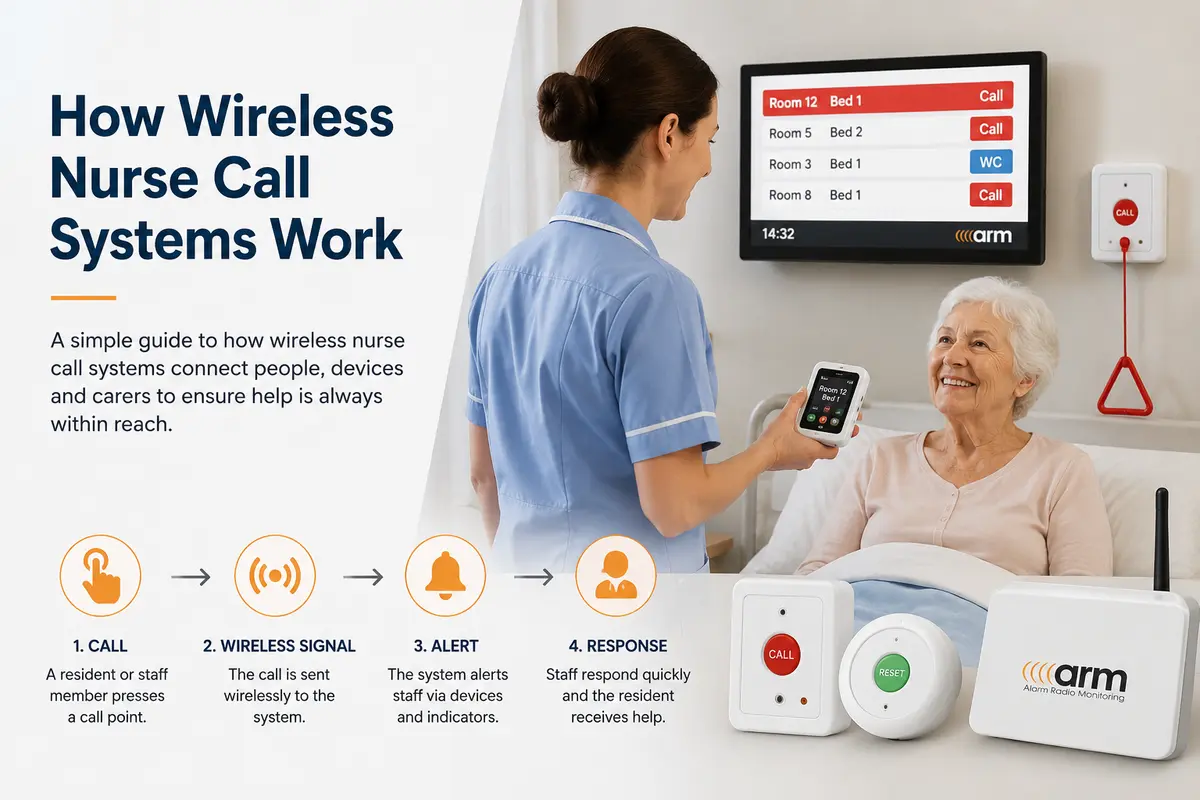
Wireless nurse call system in a care home environment with nurse responding to resident alert

Wireless nurse call systems are used in care homes, hospitals, assisted living facilities, and specialist education settings. They allow residents, patients, or staff to request help quickly without needing fixed wired call points throughout the building.

The system works by sending a wireless signal from a call device to receiving equipment elsewhere on site. Once the alert is received, it can appear on corridor lights, display panels, pagers, handheld devices, or staff stations.

Why Wireless Systems Are Used

Wireless nurse call systems have become popular because they reduce the disruption caused by installing large wired systems. This is especially useful in occupied care homes and healthcare buildings where cabling, room access, and redecoration can be difficult.

Wireless systems are also easier to expand or adapt if rooms, layouts, workflows, or resident needs change over time.

Many organisations also choose wireless infrastructure because of the operational flexibility explained in our guide to why wireless systems are often used in existing care buildings.

What Happens When a Call Is Activated

A call can be activated using a fixed call point, pull cord, wearable pendant, or personal alarm device. This may be located beside a bed, in a bathroom, or carried by a member of staff.

Once activated, the device sends a wireless alert through the system to receiving equipment on site.

  • A corridor light may turn on
  • An alert may appear on a display panel
  • A pager may be triggered
  • A handheld device may receive a notification
  • The call may escalate if it is not answered

The Importance of Reliable Coverage

Although the system is wireless, it still needs careful planning. Receivers, transmitters, control equipment, and monitoring devices must be positioned correctly to provide reliable coverage throughout the building.

Building layout, thick walls, multiple floors, lift shafts, plant rooms, and older construction materials can all affect wireless signal performance.

This is one reason many providers carefully compare wireless vs wired nurse call systems before choosing the most suitable infrastructure for the environment.

Good System Design

A well-designed wireless nurse call system should focus on more than simply installing devices. It should be planned around the building, staff workflows, and the needs of residents or patients.

  • Reliable signal coverage
  • Clear alert visibility
  • Effective response management
  • Easy future expansion
  • Simple long-term maintenance

In larger environments, system visibility and operational workflows can directly influence nurse call response times in care environments.

Modern Alert Management

Modern nurse call systems can do more than trigger an alarm. Many systems can support different alert types, priorities, and escalation procedures.

For example, a routine assistance request may be handled differently from an emergency call, staff attack alert, or movement monitoring notification.

  • Response times
  • Alert frequency
  • Device activity
  • Staff response patterns

Wireless Systems Are Not Just Temporary

Wireless nurse call systems are not only suitable for small sites or temporary installations. Many larger care and healthcare environments use wireless systems because they offer flexibility while still supporting reliable alert management.

The quality of the installation is more important than whether the system is wired or wireless. A properly planned wireless system can provide dependable performance across complex buildings.

Choosing the Right System

Different environments need different types of nurse call systems. A small care home may need a simple and easy-to-use system, while a hospital may need advanced escalation, zoning, reporting, or staff protection features.

The best system is usually designed around the environment, building layout, staff workflows, and long-term operational needs.

Care providers reviewing new infrastructure may also find it useful to understand what care homes should consider when choosing a nurse call system.

Long-Term Support

Nurse call systems need ongoing support after installation. Devices require testing, batteries need monitoring, and the system may need to be adapted as requirements change.

In care and healthcare settings, reliable communication is essential for everyday safety. Long-term maintenance, fault management, replacement parts, and technical support are therefore just as important as the initial installation.

As systems age, many organisations also begin reviewing common problems with nurse call systems and planning future upgrades accordingly.
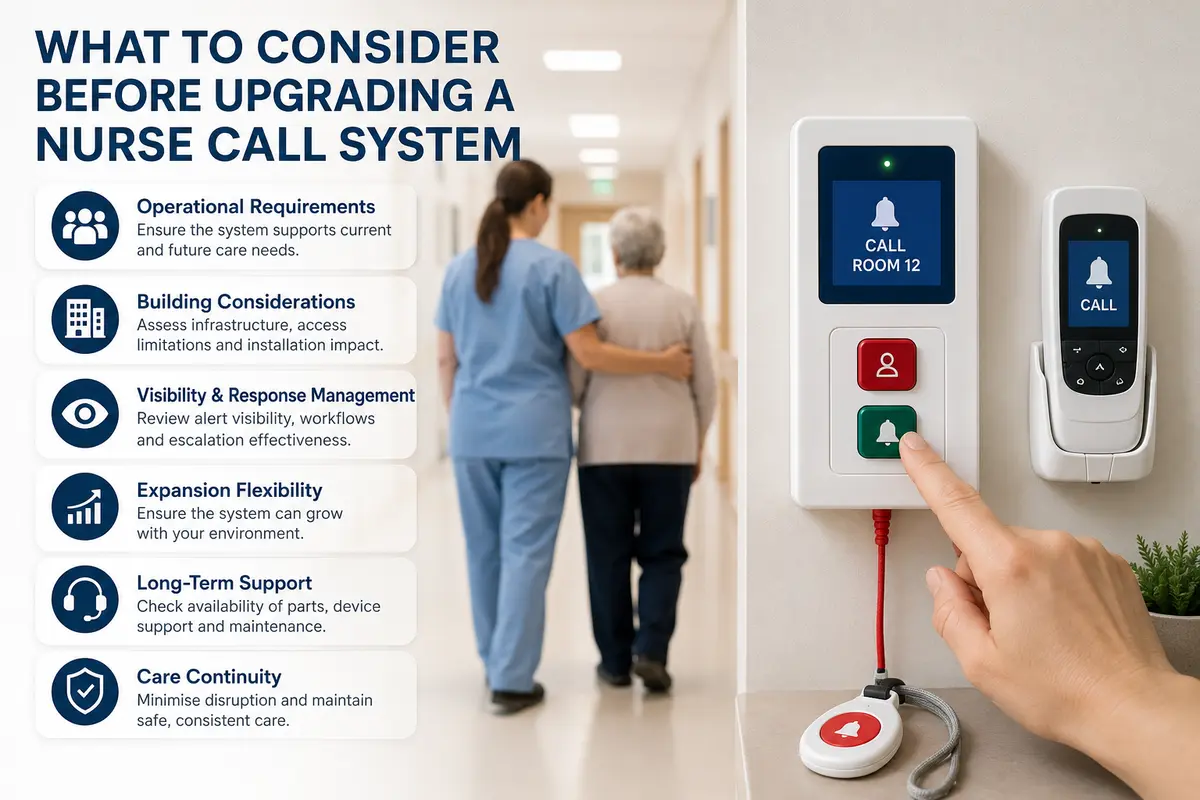
Nurse call system upgrade illustration showing wireless call devices, healthcare staff, and care home communication equipment

In many care environments, nurse call upgrades are introduced gradually as operational requirements change, rather than because the existing system has stopped functioning entirely. A system may still appear operational day to day, while underlying limitations begin to affect response visibility, maintenance efficiency, expansion flexibility, or long-term reliability across the building.

That is why upgrading a nurse call system is rarely just a technical replacement project. In practice, it usually involves reviewing how the environment currently functions, how communication workflows have evolved over time, and whether the existing infrastructure still effectively supports day-to-day care delivery.

The strongest upgrade projects are normally the ones planned around operational realities, rather than simply replacing equipment like-for-like.

Operational Requirements Often Change Faster Than Infrastructure

Many care homes and healthcare environments evolve gradually over time. Resident dependency levels may increase, staffing structures may change, extensions may be added, and safeguarding requirements may become more complex compared with when the original system was first installed.

In some environments, infrastructure that worked well several years ago may begin to create operational limitations simply because the building and maintenance requirements surrounding it have changed significantly.

This may become noticeable through:

  • Inconsistent alert visibility
  • Slower response coordination
  • Expansion difficulties
  • Increasing maintenance requirements
  • Limited integration capability
  • Ageing devices becoming harder to support

The issue is not always that the system has failed. More commonly, the environment has outgrown the assumptions the original infrastructure was designed around.

Many providers first begin identifying these operational limitations while reviewing common problems with nurse call systems across older environments.

Existing Buildings Often Create Upgrade Challenges

Many care environments operate in buildings that have been repeatedly adapted over time, rather than being purpose-built around modern communication infrastructure.

Older care homes, converted residential properties, phased extensions, and long-established healthcare environments can all create practical limitations when systems need upgrading.

In some buildings, introducing additional cabling may involve:

  • Ceiling access
  • Flooring work
  • Redecoration
  • Room disruption
  • Temporary operational adjustments
  • Restricted installation routes

That is one reason many organisations review wireless infrastructure during upgrade planning, particularly where maintaining day-to-day continuity of care remains a major operational priority.

The practical realities of the building itself usually influence upgrade decisions just as much as the system’s technical specification.

Our guide to wireless systems in existing care buildings explains why retrofit flexibility is often important during phased upgrades.

Visibility And Response Management Should Be Reviewed Carefully

One of the most important parts of any upgrade review is understanding how effectively alerts are currently being recognised and managed throughout the environment.

A system may still activate correctly while operational visibility has become weaker over time because of:

  • Staffing movement changes
  • Extensions or layout alterations
  • Inconsistent corridor visibility
  • Growing reliance on mobile communication
  • Increased alert activity
  • Evolving resident support requirements

In larger environments, especially, response efficiency often depends as much on visibility and workflow alignment as the infrastructure itself.

This is why upgrade assessments should normally focus on:

  • How staff move throughout the building
  • How alerts are prioritised
  • Where visibility limitations occur
  • How overnight response differs operationally
  • Whether escalation procedures remain effective

rather than simply reviewing hardware age alone.

In many environments, operational visibility also depends heavily on properly configured nurse call corridor lights and clear alert management throughout the building.

Expansion Flexibility Becomes Increasingly Important

Many organisations begin considering upgrades when existing infrastructure becomes difficult to expand.

Additional rooms, monitoring devices, safeguarding measures, or communication requirements may gradually exceed what the original system was designed to support efficiently.

In wired environments, particularly, introducing additional infrastructure later can sometimes become operationally complex if:

  • Cabling routes are restricted
  • Building layouts have changed
  • Documentation is incomplete
  • Legacy devices are no longer supported
  • Infrastructure has evolved in phases over many years

This does not necessarily mean complete replacement is required immediately. In many environments, phased upgrades or hybrid infrastructure approaches are operationally more realistic than full replacement projects completed all at once.

For organisations assessing future infrastructure flexibility, comparing wireless vs wired nurse call systems can help clarify some of the operational differences between both approaches.

Long-Term Support Availability Matters

One of the less visible issues affecting older nurse call systems is the availability of long-term support.

A system may still operate reliably day to day while:

  • Replacement devices become limited
  • Batteries become harder to source
  • Legacy components are discontinued
  • Maintenance response becomes slower
  • Integration with newer infrastructure becomes restricted

Over time, this can make fault resolution and future expansion increasingly difficult operationally.

That is why support planning is often just as important as the infrastructure itself during upgrade discussions.

For many organisations, the question is not only whether the system works today, but also whether it can be reliably maintained and adapted for several years into the future.

Care Continuity Usually Shapes The Upgrade Approach

Unlike many commercial environments, care homes and healthcare settings cannot simply pause normal operations while infrastructure is replaced.

Residents still require assistance, staff workflows must continue functioning safely, and safeguarding responsibilities remain fully active throughout installation work.

Because of this, upgrade planning often focuses heavily on:

  • Phased installation
  • Minimising disruption
  • Maintaining alert coverage throughout works
  • Preserving overnight operational visibility
  • Avoiding unnecessary resident disturbance

This is particularly important in:

  • Dementia care environments
  • High-dependency settings
  • Occupied healthcare buildings
  • Environments with vulnerable residents
  • Multi-wing care facilities

The operational continuity of the environment usually becomes one of the most important factors shaping how upgrades are delivered.

Wireless Infrastructure Is Often Reviewed During Upgrades

Many organisations reviewing older systems now consider whether wireless infrastructure may provide greater long-term flexibility within the environment.

This is not simply because wireless systems reduce cabling. More often, it is because they can make future adaptation easier operationally as buildings and care requirements continue evolving over time.

In existing care environments, wireless systems may help reduce:

  • Installation disruption
  • Structural alteration
  • Phased expansion difficulty
  • Future device relocation complexity

while still allowing the communication infrastructure to expand alongside operational changes within the building.

The suitability of wireless infrastructure still depends heavily on proper site assessment, signal planning, and operational design rather than the technology alone.

Upgrades Should Reflect How The Environment Functions

One of the most common mistakes during nurse call upgrades is assuming the replacement system should mirror the previous installation exactly.

In practice, environments often function very differently compared with when the original infrastructure was first introduced. Staffing workflows, resident needs, safeguarding priorities, and building layouts may all have evolved significantly over time.

The strongest upgrade projects usually begin by asking:

  • How staff communicate today
  • Where visibility limitations currently exist
  • How residents request assistance
  • What operational pressures have changed
  • How future expansion is likely to develop
  • Where response coordination can be improved

rather than simply replacing hardware room by room.

Many organisations also review care home nurse call systems differently once staffing workflows and safeguarding priorities have evolved over time.

The Objective Is Long-Term Operational Suitability

At its core, a nurse call system exists to support safe and manageable communication throughout the environment. Upgrading that infrastructure is therefore not only about introducing newer equipment. It is about ensuring the system continues to support the building’s operational reality as care delivery requirements evolve over time.

For some environments, that may involve phased wireless expansion. For others, it may involve improving visibility, simplifying workflows, integrating additional safeguarding measures, or resolving long-standing infrastructure limitations.

The most effective upgrades are usually the ones designed around how the environment operates day to day, rather than technology alone.

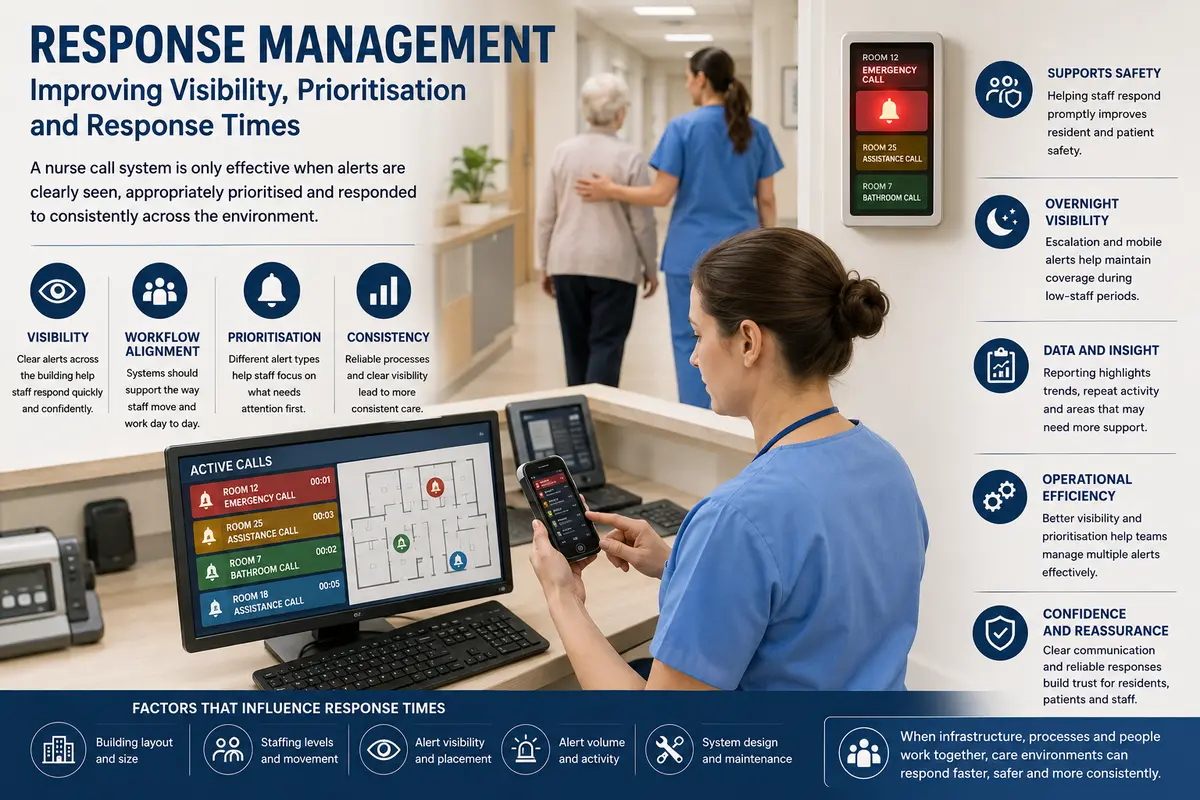
Healthcare staff using nurse call response management systems with mobile alerts, prioritisation screens, and care home communication monitoring

In most care environments, response times are influenced as much by visibility, staffing workflows, and operational organisation as they are by the nurse call infrastructure itself. A nurse call system may function perfectly technically, but if alerts are not clearly recognised or staff cannot prioritise responses effectively, delays can still occur during day-to-day operation.

That is why response management is usually viewed as an operational issue rather than simply a technical one.

Within care homes, hospitals, assisted living environments, and specialist care settings, nurse call systems support communication among residents, patients, and staff. How quickly and consistently those alerts are acknowledged often affects not only efficiency but also reassurance, safeguarding, and confidence within the environment itself.

Response Times Are Not Only About Emergencies

When people think about nurse call systems, the focus often goes immediately to emergency situations. In practice, however, most alerts relate to routine assistance requests rather than immediate medical emergencies.

Residents may require help with mobility, toileting, repositioning, reassurance, or general support throughout the day and night. In many care environments, these requests happen continuously across multiple rooms and staff teams simultaneously.

Because of this, response management is rarely about responding to one isolated alert at a time. Staff are normally balancing multiple priorities across the building while maintaining visibility into active calls, ongoing assistance, and changing resident needs.

The system, therefore, needs to support manageable communication rather than simply generating notifications.

Visibility Often Determines How Efficiently Staff Respond

One of the biggest influences on response efficiency is how clearly alerts can be identified throughout the environment.

In smaller care homes, corridor lights and local annunciation may provide sufficient visibility. In larger buildings, staff may rely more heavily on pagers, handheld devices, mobile alerts, or central display systems because teams are spread across multiple floors or wings.

If alert visibility becomes inconsistent, delayed responses can develop gradually, even when the system itself remains technically operational.

This can happen for several reasons:

  • Poor corridor light positioning
  • Limited visibility around extensions or corners
  • Over-reliance on a single alert method
  • High background activity levels
  • Staffing movement across large areas
  • Alert fatigue during busy periods

In practice, visibility problems are often operationally subtle before they become obvious formally.

Staffing Workflows Influence Response Consistency

Nurse call systems operate within environments that are constantly moving. Staff are supporting residents, carrying out care tasks, managing medication rounds, responding to incidents, and moving continuously throughout the building.

If the communication infrastructure does not align with those workflows, response management becomes more difficult regardless of the system’s specifications.

For example, a care environment that relies heavily on desk-based annunciation may struggle to operate if staff are rarely positioned near central stations during busy periods. Equally, mobile alerting systems may become less effective if notifications are inconsistent or if multiple simultaneous alerts reduce the clarity of prioritisation.

This is one reason response management should usually be reviewed alongside staffing movement patterns rather than viewed purely as a technology issue.

The strongest systems are often the ones that fit naturally into how staff already operate day to day.

Overnight Care Creates Different Operational Pressures

Response management often changes significantly overnight.

Staffing levels are typically lower, buildings are quieter, and teams may be covering wider areas simultaneously. Under these conditions, visibility and prioritisation become even more important operationally.

A call that would normally be identified immediately during daytime activity may take longer to recognise if staff are assisting elsewhere or moving between floors.

This does not necessarily indicate poor care delivery. It reflects the operational realities of many care environments during periods of reduced staffing.

Because of this, some systems use:

  • Escalation procedures
  • Repeated alerting
  • Mobile notifications
  • Prioritised emergency call routing
  • Enhanced visual indication

to help maintain response visibility overnight.

The objective is usually to reduce the likelihood that alerts become isolated operationally while staff are occupied elsewhere in the building.

Delayed Responses Often Develop Gradually

One of the more difficult aspects of response management is that problems rarely appear suddenly.

In many environments, delayed responses emerge gradually over time as:

  • Staffing structures change
  • Occupancy increases
  • Layouts evolve
  • Extensions are added
  • Resident dependency levels increase
  • Systems expand beyond their original design assumptions

The infrastructure itself may still operate correctly, but operational demands surrounding the system have changed significantly.

This is why regular reassessment matters.

A nurse call system that suited the environment perfectly several years ago may no longer fully align with how the building functions operationally today.

Many organisations eventually begin reviewing what to consider before upgrading a nurse call system once these operational pressures start affecting response consistency.

Alert Prioritisation Becomes Increasingly Important In Larger Environments

In larger care homes and healthcare settings, staff often manage multiple alerts simultaneously across different parts of the building.

Without clear prioritisation, all alerts may appear operationally equal, even when urgency levels differ significantly.

Modern systems may therefore separate:

  • Standard assistance calls
  • Emergency alerts
  • Bathroom alarms
  • Staff attack notifications
  • Monitoring alerts
  • Movement or wandering alarms

This helps staff recognise which situations require immediate attendance and which can be managed within normal workflow response times.

The objective is not necessarily to create faster responses to every alert. More often, it is to clarify which alerts require prioritisation under operational pressure.

Reporting And Response Analysis Can Highlight Operational Trends

Many modern nurse call systems now include reporting and audit capabilities that allow management teams to review response patterns over time.

This may include:

  • Response duration
  • Repeated alert activity
  • Unanswered calls
  • High-frequency assistance areas
  • Overnight response patterns
  • Staffing visibility trends

Used properly, this information can help identify operational pressure points before they become larger safeguarding or workflow concerns.

In some environments, the reporting side of the system becomes one of the most valuable tools for long-term operational planning rather than simply a technical monitoring feature.

Many healthcare providers also integrate nurse call data analysis tools to review response activity and operational trends more effectively.

Consistency Is Usually More Important Than Speed Alone

Response times are often discussed in terms of speed, but in practice, consistency tends to matter more operationally.

A system that allows staff to reliably recognise, prioritise, and manage alerts throughout the day is usually more effective than one focused purely on achieving isolated, rapid-response targets.

Care environments are dynamic. Staff are continuously balancing multiple responsibilities, and not every alert carries the same level of urgency. The communication infrastructure, therefore, needs to support clear operational awareness rather than creating unnecessary complexity or alert overload.

That usually comes down to:

  • Visibility
  • Reliability
  • Staffing alignment
  • Prioritisation clarity
  • Operational suitability
  • Consistent maintenance

rather than one individual feature alone.

Nurse Call Systems Support Communication, Not Just Alerts

At their best, nurse call systems form part of the wider communication structure that allows care environments to function safely and efficiently day to day.

The system is not simply there to generate alarms. It helps staff understand where assistance is required, how urgently support is needed, and how care teams coordinate response activity across the building.

When response management works well, the technology itself often becomes less noticeable in operational terms because communication feels predictable, visible, and manageable across the environment.

That consistency usually results from infrastructure, staffing workflows, visibility, maintenance, and operational design working together, rather than from any single piece of equipment alone.

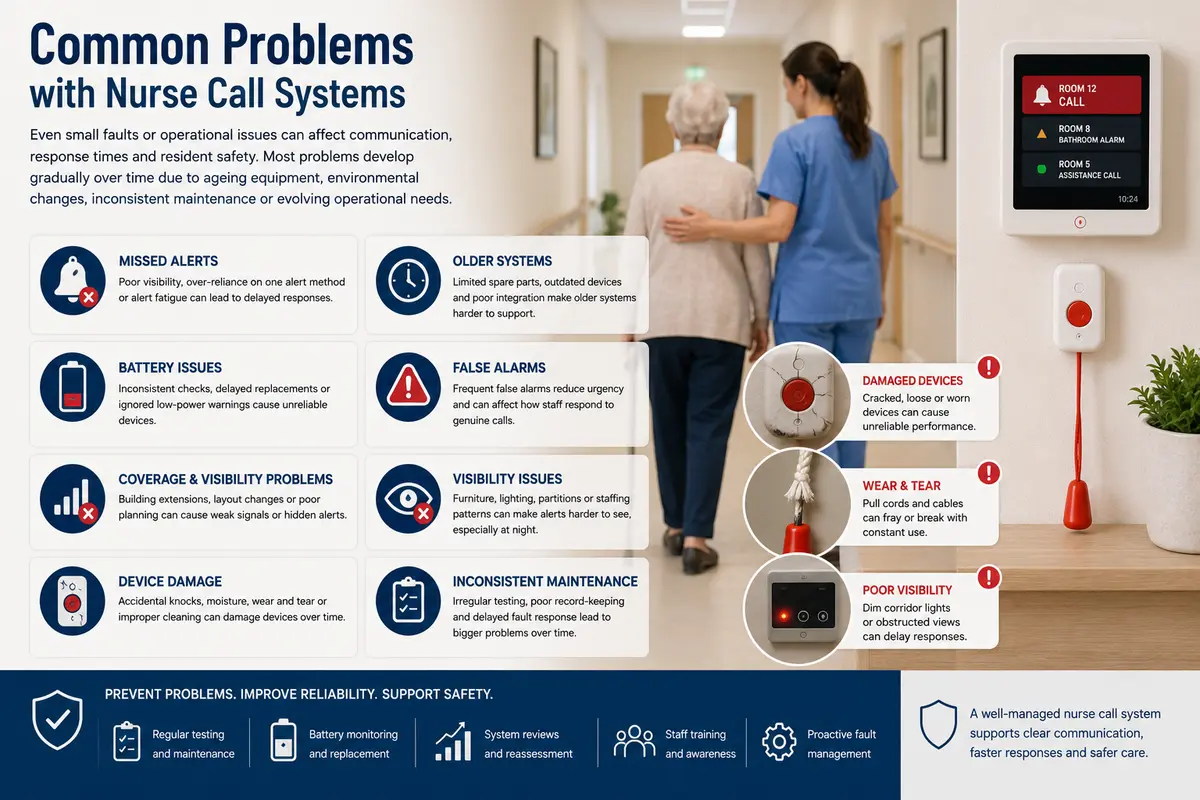
Illustration showing common nurse call system problems including missed alerts, battery issues, damaged devices, poor visibility, and maintenance challenges in a care home

Nurse call systems are expected to operate continuously in environments where communication, response times, and resident safety are integral to everyday care delivery. Because of that, even relatively small faults or operational issues can become significant surprisingly quickly if they are left unresolved.

In practice, most nurse call problems are not caused by complete system failure. More commonly, issues develop gradually over time due to ageing infrastructure, inconsistent maintenance, environmental changes, or systems that no longer meet the building’s operational demands.

Understanding where those problems typically arise is often more useful than simply focusing on the technology itself.

Missed Alerts Are Usually an Operational Issue Before a Technical One

One of the most serious concerns within any nurse call environment is the possibility of alerts being missed or responded to late.

In some cases, this may be caused by equipment faults, signal issues, or damaged devices. More often, however, missed alerts occur because the system no longer aligns with how staff actually work in the building.

For example, a corridor light positioned poorly in an extended wing may reduce visibility during overnight staffing. In larger homes, staff may rely heavily on pagers or mobile alerts, while visual indicators become less effective in practice. In other environments, frequent low-priority alerts can gradually create desensitisation, so urgent calls no longer stand out clearly during busy periods.

The system itself may still be technically operational, but response visibility becomes weaker in practice.

That distinction matters.

Battery Management Is Often Overlooked

Wireless nurse call systems rely heavily on battery-powered devices throughout the building. Pendant alarms, call points, pull cords, wearable devices, and monitoring equipment all require ongoing battery monitoring if the system is expected to remain reliable in the long term.

Most modern systems include battery monitoring and low-power warnings, but problems can still emerge where:

  • Testing schedules are inconsistent
  • Replacement cycles are delayed
  • Devices remain in service beyond expected lifespan
  • Battery warnings are ignored during busy periods

In some environments, battery issues develop gradually enough that they are only identified once devices begin behaving inconsistently or failing intermittently.

Good maintenance procedures usually prevent most of these problems before they affect day-to-day operation significantly.

Expansion Sometimes Creates Coverage or Visibility Problems

Many care environments evolve gradually over time. Rooms are repurposed, extensions are added, layouts change, and additional monitoring devices are introduced as operational requirements develop.

If those changes are not reflected properly within the nurse call infrastructure, systems can become uneven operationally. New areas may have weaker signal coverage, alert visibility may become inconsistent, or staff workflows may shift in ways the original system design never anticipated.

This is particularly common in:

  • Older buildings
  • Phased refurbishments
  • Converted properties
  • Environments with multiple extensions
  • Sites that have expanded gradually over many years

The original system may still function well technically, but the operational environment surrounding it has changed considerably.

That is why periodic reassessment is often just as important as routine maintenance.

Many providers encounter these operational pressures when reviewing older nurse call systems during upgrade planning.

Device Damage Is Common in Busy Care Environments

Nurse call devices operate within environments where equipment is used continuously throughout the day and night. Pull cords, pendants, call buttons, corridor indicators, and personal alarms all experience ongoing physical use within high-traffic areas.

Over time, devices can become damaged through:

  • Accidental knocks
  • Improper cleaning
  • Moisture exposure
  • Wear and tear
  • Repeated impact
  • Battery compartment damage
  • Cable strain on older infrastructure

In some cases, the damage is obvious immediately. In others, devices continue to operate intermittently, creating unreliable behaviour that becomes increasingly difficult to identify consistently.

Routine testing helps reduce the likelihood of these issues developing unnoticed.

Older Systems Can Become Difficult to Support

Some nurse call systems remain operational for many years, particularly in healthcare environments where infrastructure replacement is phased gradually rather than completed all at once.

The challenge is not always whether the system still works. More commonly, support becomes more complicated as:

  • Replacement parts become limited
  • Older devices are discontinued
  • Documentation becomes outdated
  • Expansion capability becomes restricted
  • Integration with newer infrastructure becomes difficult

Older wired systems may also become harder to maintain where cabling routes are no longer clearly documented or where building alterations have affected access to infrastructure over time.

This does not necessarily mean older systems require immediate replacement, but it does increase the importance of long-term support planning.

Many environments eventually begin comparing wireless vs wired nurse call systems once older infrastructure becomes harder to maintain operationally.

False Alarms Can Affect Response Behaviour

Frequent false alarms are often treated as a minor inconvenience initially, but over time, they can affect how staff respond to alerts operationally.

If certain devices trigger repeatedly without genuine assistance being required, staff may begin anticipating non-urgent activations before reaching the room itself. In busy environments, that shift in expectation can gradually reduce urgency and affect response consistency.

False alarms may develop because of:

  • Damaged call devices
  • Environmental interference
  • Inappropriate device placement
  • Accidental activation
  • Incorrect configuration
  • Worn components

The underlying cause is not always technical failure alone. In some environments, system configuration simply no longer reflects how rooms or equipment are being used operationally.

Visibility Issues Often Emerge Gradually

Visual alerting remains one of the most important aspects of nurse call infrastructure, particularly in care homes and other large residential environments.

As buildings evolve over time, however, visibility problems sometimes emerge gradually without being recognised immediately. Furniture changes, lighting adjustments, partitioning, extensions, or revised staffing patterns can all affect how clearly alerts are identified throughout the building.

This becomes especially important:

  • Overnight
  • During reduced staffing periods
  • In larger wings
  • Around corners or split-level layouts
  • Within dementia care environments

A system may still trigger alerts correctly while operational visibility becomes progressively weaker.

That is one reason system reviews should focus on how the environment functions day-to-day rather than simply on whether devices technically activate.

Many of these operational concerns directly affect nurse call response times in care environments.

Maintenance Consistency Usually Determines Long-Term Reliability

Most serious nurse call problems do not appear suddenly. More often, they develop gradually, where maintenance, testing, or operational review becomes inconsistent over time.

Healthcare and care environments place constant demands on the communication infrastructure. Devices are used continuously, staffing patterns evolve, operational layouts change, and safeguarding requirements become more complex as environments adapt.

Long-term reliability, therefore, depends heavily on:

  • Routine testing
  • Battery management
  • Fault response
  • Operational reassessment
  • Infrastructure support
  • Staff familiarity with the system

The strongest nurse call systems are usually the ones that continue to evolve alongside the environment itself rather than remain static as operational demands change around them.

The System Should Support the Way the Environment Actually Works

One of the most common causes of operational frustration is not an outright system failure but a gradual mismatch between the infrastructure and the building’s day-to-day reality.

A nurse call system that suited the environment perfectly five years ago may no longer align with:

  • Staffing structures
  • Resident dependency levels
  • Building layouts
  • Safeguarding measures
  • Response workflows
  • Operational priorities

That is why reviewing how the system functions operationally is often just as important as addressing individual technical faults.

In practice, the most reliable environments are usually not the ones with the most complicated systems. They are environments where communication infrastructure, staff workflows, visibility, and maintenance continue to work together consistently as building and care requirements evolve over time.

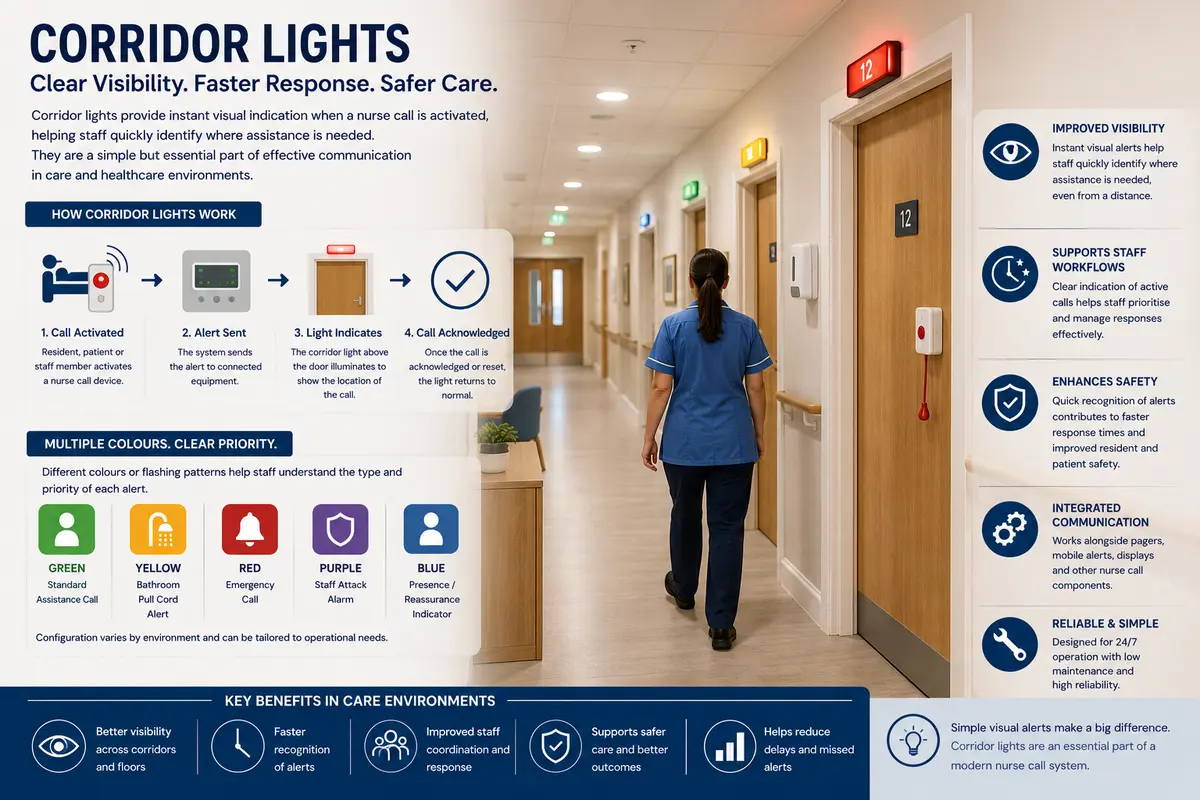
Corridor lights used in a nurse call system within a care home hallway showing visual alert indicators above resident room doors

Corridor lights are among the simplest yet most operationally important components of a nurse call system. In busy care environments, staff often identify active alerts visually before they check a display panel, handheld device, or pager notification.

For that reason, corridor lights are not simply an accessory added onto a system. In many care homes and healthcare environments, they form part of the day-to-day visibility that helps staff quickly and clearly recognise where assistance is required.

Their importance often becomes even more obvious during busy periods, overnight staffing conditions, or in larger environments where staff movement is spread across multiple corridors or floors.

How Corridor Lights Work Within a Nurse Call System

When a resident, patient, or staff member activates a nurse call device, the system sends an alert to connected notification equipment throughout the building. Corridor lights provide a visual indication that a call has been triggered and usually identify the room or area requiring assistance.

In many environments, the corridor light sits above the bedroom, bathroom, or doorway connected to the active call point. Once the call is acknowledged or reset, the light returns to its normal state.

The principle itself is straightforward. What matters operationally is how clearly those alerts can be identified within the working environment.

In care settings where staff may already be moving between rooms, supporting residents, or handling multiple tasks simultaneously, quick visual recognition often considerably improves response efficiency.

This forms an important part of wider nurse call response management throughout busy care environments.

Different Light Colours Often Indicate Different Alert Types

Many modern nurse call systems use multiple colours or flashing sequences to help staff identify the nature or priority of the alert.

For example, systems may differentiate between:

  • Standard assistance calls
  • Emergency alarms
  • Bathroom pull cord alerts
  • Staff attack alarms
  • Presence indication
  • Reassurance or reset functions

The exact configuration varies depending on the environment and the site’s operational requirements.

In some care homes, keeping the system simple and highly visible is more important than introducing multiple complex alert states. In larger healthcare environments, however, more advanced visual differentiation may help staff prioritise response more effectively across multiple areas.

The most effective setup is usually the one that staff can recognise quickly and consistently under normal working conditions.

Visibility Matters More Than People Sometimes Expect

The positioning and visibility of corridor lights can directly affect how effectively alerts are recognised throughout the building.

In older care homes or converted properties, corridor layouts are not always straightforward. Corners, extensions, split-level layouts, narrow hallways, and inconsistent lighting conditions can all affect how easily alerts are seen during normal operation.

That is why corridor lights are normally considered as part of the wider system design rather than added purely as a finishing detail.

In practice, visibility often matters most:

  • During overnight staffing
  • In dementia care environments
  • During periods of reduced staffing levels
  • In larger homes with multiple wings
  • Where staff are frequently mobile rather than desk-based

A well-positioned visual alert system can reduce delays in identifying calls, particularly when staff are already working elsewhere within the building.

Many providers first begin reviewing visibility concerns while assessing common problems with nurse call systems in older environments.

Corridor Lights Also Support Reassurance and Workflow Visibility

Beyond emergency response, corridor lights often help staff manage everyday workflow throughout the home.

Presence indicators, reassurance functions, and staff attendance notifications can all contribute to clearer visibility regarding which rooms are currently being attended to and which calls still require response.

In some environments, this helps avoid duplication where multiple staff unknowingly respond to the same call while other alerts remain unattended elsewhere.

Simple visual status indication can therefore improve operational flow without introducing unnecessary complexity into the system itself.

Dementia Care Environments May Require Additional Consideration

In dementia care settings, visual alert systems sometimes need to be balanced carefully against the wider environment.

Highly intrusive flashing systems may increase agitation or confusion for some residents, while insufficient visibility may reduce staff awareness during busy periods. Because of this, corridor light configuration often becomes more dependent on the operational realities of the home itself rather than simply following a standard layout approach.

In specialist environments, systems may need to support:

  • Discreet alert visibility
  • Zoning
  • Silent alert escalation
  • Staff-only notification arrangements
  • Integration with monitoring devices

The objective is usually to maintain clear staff communication while preserving a calm and manageable resident environment wherever possible.

Integration with Wider Nurse Call Infrastructure

Corridor lights rarely operate in isolation. In most installations, they form part of a wider nurse call infrastructure that may also include:

  • Annunciator panels
  • Pagers
  • Mobile staff alerts
  • Display screens
  • Emergency alarms
  • Door monitoring systems
  • Staff attack alarms

This layered approach allows alerts to remain visible through multiple communication methods simultaneously.

In practice, visual indication often serves as one component of a broader response system rather than the sole method for alert management.

That redundancy can become particularly important during busy operational periods where staff attention is divided across multiple tasks and environments.

Many organisations integrate corridor indication alongside wireless nurse call systems to maintain clearer building-wide visibility.

Maintenance and Reliability Considerations

Like all nurse call components, corridor lights require ongoing maintenance and testing to ensure they remain fully operational.

A failed visual indicator may appear relatively minor initially, but in practice it can reduce response visibility considerably within certain areas of the building.

Routine testing usually forms part of wider nurse call maintenance procedures and may include:

  • Light functionality checks
  • Colour sequence verification
  • Connection testing
  • Alert integration checks
  • Visibility assessment

In larger or older environments, maintaining consistency across multiple areas of the site is often just as important as the functionality of individual devices themselves.

Many providers also review corridor indication during wider discussions around upgrading nurse call systems in ageing buildings.

Simple Visibility Often Improves Response Management

Modern nurse call systems may involve software integration, mobile alerts, escalation logic, and reporting capabilities, but visual alerting remains one of the most effective communication methods in many care environments.

Staff working in busy healthcare settings often rely on immediate environmental awareness as much as digital notifications. Corridor lights maintain that awareness throughout the building without requiring staff to stop, check a screen, or constantly monitor a handheld device.

That simplicity is part of why corridor lights remain widely used in modern nurse call infrastructure.

In many environments, the most effective systems are not necessarily the most complicated. They are the systems that enable staff to clearly recognise, prioritise, and respond to assistance requests in everyday working conditions.

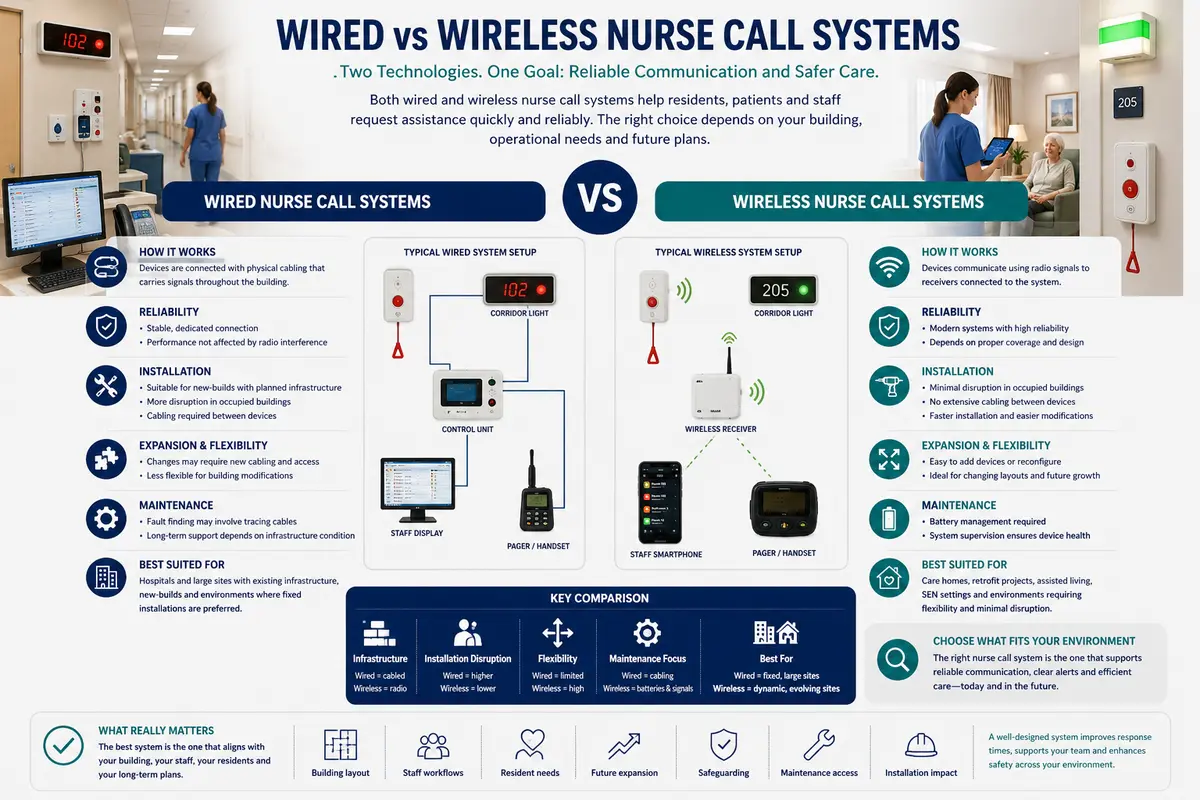
Comparison infographic showing wired and wireless nurse call systems used in healthcare and care home environments with communication devices and alert infrastructure

Wireless and wired nurse call systems are both designed to achieve the same core objective: allowing residents, patients, or staff to request assistance quickly and reliably within healthcare and care environments. The difference lies in how those systems communicate throughout the building and how easily the infrastructure can adapt over time.

In practice, the decision between wireless and wired systems is rarely about one technology being universally better than the other. The building itself, the operational environment, installation constraints, and long-term flexibility requirements usually determine which approach is most suitable.

How Traditional Wired Systems Operate

Wired nurse call systems use physical cabling between call points, corridor indicators, control equipment, displays, and staff communication devices. In many hospitals and older healthcare facilities, wired infrastructure has historically been the standard approach because it provides a fixed communication network throughout the site.

In controlled environments where infrastructure is already in place, wired systems can offer long-term stability with clearly defined device locations and fixed installation pathways.

Many larger healthcare sites still operate highly effective wired systems today, particularly where infrastructure has evolved gradually over many years rather than being installed as part of a complete replacement project.

That said, wired infrastructure can become more difficult to adapt as operational requirements change. Expanding into additional rooms, altering layouts, or introducing new devices may require further cabling work, ceiling access, containment adjustments, or temporary disruption within occupied areas.

Why Wireless Systems Have Become More Common

Wireless nurse call systems became increasingly popular as care environments sought to reduce installation disruption while improving flexibility.

In occupied care homes, assisted living environments, SEN settings, and retrofit healthcare buildings, large-scale cabling work is not always practical. Running new wired infrastructure through active resident areas can involve room access, lifting flooring, ceiling work, redecoration, and temporary operational inconvenience, all of which may be difficult to manage safely.

Wireless systems reduce much of that disruption.

Because devices communicate using radio infrastructure rather than direct cabling between every point, installations can often be completed more efficiently while allowing systems to expand more easily later if rooms, workflows, or operational requirements change.

That flexibility has made wireless systems particularly common within:

  • Care homes
  • Retrofit healthcare environments
  • Assisted living schemes
  • SEN schools
  • Respite facilities
  • Temporary healthcare spaces

In many cases, the ability to adapt the system over time becomes just as valuable as the initial installation itself.

This is one reason many providers now review wireless systems in existing care buildings when planning upgrades.

Installation Disruption Is Often a Major Factor

One of the biggest operational differences between wired and wireless systems is the level of disruption associated with installation and future expansion.

In new-build environments where cabling routes are already accessible, wired infrastructure may integrate relatively easily during construction. In occupied buildings, however, installation becomes more complicated.

Care environments rarely stop operating while infrastructure work takes place. Residents still require assistance, staff workflows still need to function normally, and safeguarding considerations remain in place throughout the installation process.

That is one reason wireless systems are frequently favoured in existing care environments. Additional devices, room changes, or system extensions can usually be introduced with significantly less disruption to day-to-day operations.

This becomes particularly important in older buildings where retrofitting new cabling may be structurally difficult or operationally impractical.

Reliability Depends More on System Design Than Technology Alone

There is sometimes an assumption that wired systems are automatically more reliable than wireless systems. In practice, reliability depends far more on the quality of system design, infrastructure planning, installation standards, and ongoing maintenance.

A poorly designed wired system can create operational limitations just as easily as a poorly configured wireless installation can create signal coverage issues.

Wireless systems rely heavily on:

  • Correct receiver positioning
  • Signal consistency
  • Building assessment
  • Interference management
  • Proper commissioning

Wired systems rely on:

  • Cabling integrity
  • Infrastructure condition
  • Network continuity
  • Physical installation quality
  • Long-term maintenance access

Both approaches require careful planning if they are expected to operate reliably within demanding healthcare environments.

The operational reality of the site usually matters more than broad assumptions about one technology being inherently superior.

Many organisations only begin identifying operational limitations while reviewing common problems with nurse call systems in ageing environments.

Expansion and Long-Term Flexibility

Long-term flexibility is often where wireless systems become particularly attractive operationally.

Healthcare and care environments rarely remain static for long periods. Rooms may be repurposed, monitoring requirements may change, occupancy levels may shift, and additional safeguarding measures may need to be introduced over time.

In wired systems, these changes can require further infrastructure work to extend cabling routes or reposition fixed devices. Wireless systems generally allow additional devices to be integrated more easily without major structural work.

That does not necessarily make wireless systems simpler overall, but it does often make future adaptation more manageable operationally.

For organisations planning phased upgrades or gradual expansion, that flexibility can become a significant advantage.

These considerations are often discussed during reviews of nurse call system upgrades within existing care environments.

Maintenance Considerations Are Different

Maintenance requirements also differ between wired and wireless systems.

Wired systems often require fault tracing across physical cabling infrastructure, particularly in older installations where documentation may have changed over time. Locating faults can sometimes involve accessing ceilings, wall voids, or legacy infrastructure routes.

Wireless systems remove much of that cabling dependency but introduce other considerations, including:

  • Battery monitoring
  • Signal supervision
  • Device health management
  • Receiver coverage verification

Neither approach is maintenance-free.

What matters most is whether the system can be maintained consistently and supported effectively over the long term within the operational demands of the environment.

Some Environments Now Use Hybrid Approaches

In practice, many organisations no longer view the decision as entirely wireless or entirely wired.

Hybrid approaches are increasingly common, particularly within larger healthcare environments where certain infrastructure may remain wired while additional areas, extensions, or specialist monitoring devices are introduced wirelessly.

This allows organisations to expand or modernise systems gradually without replacing all infrastructure simultaneously.

In some environments, that staged approach is operationally more realistic than attempting a complete system replacement in a single project.

Choosing the Right System for the Environment

The most suitable nurse call system is usually the one that best aligns with the building’s operational realities, rather than simply the newest available technology.

A modern care home prioritising flexibility and minimal disruption may favour wireless infrastructure from the outset. A hospital with extensive existing infrastructure may continue to operate highly effective wired systems for many years while gradually introducing wireless capabilities where appropriate.

The important question is not simply whether a system is wired or wireless. It is whether the infrastructure supports reliable communication, clear alert management, safe response procedures, and long-term operational usability within the environment itself.

That assessment normally requires consideration of:

  • Building layout
  • Installation constraints
  • Future expansion plans
  • Staffing workflows
  • Safeguarding requirements
  • Ongoing maintenance access
  • Operational disruption during installation

The strongest systems are usually those designed around how the environment functions day to day, rather than around technology labels alone.

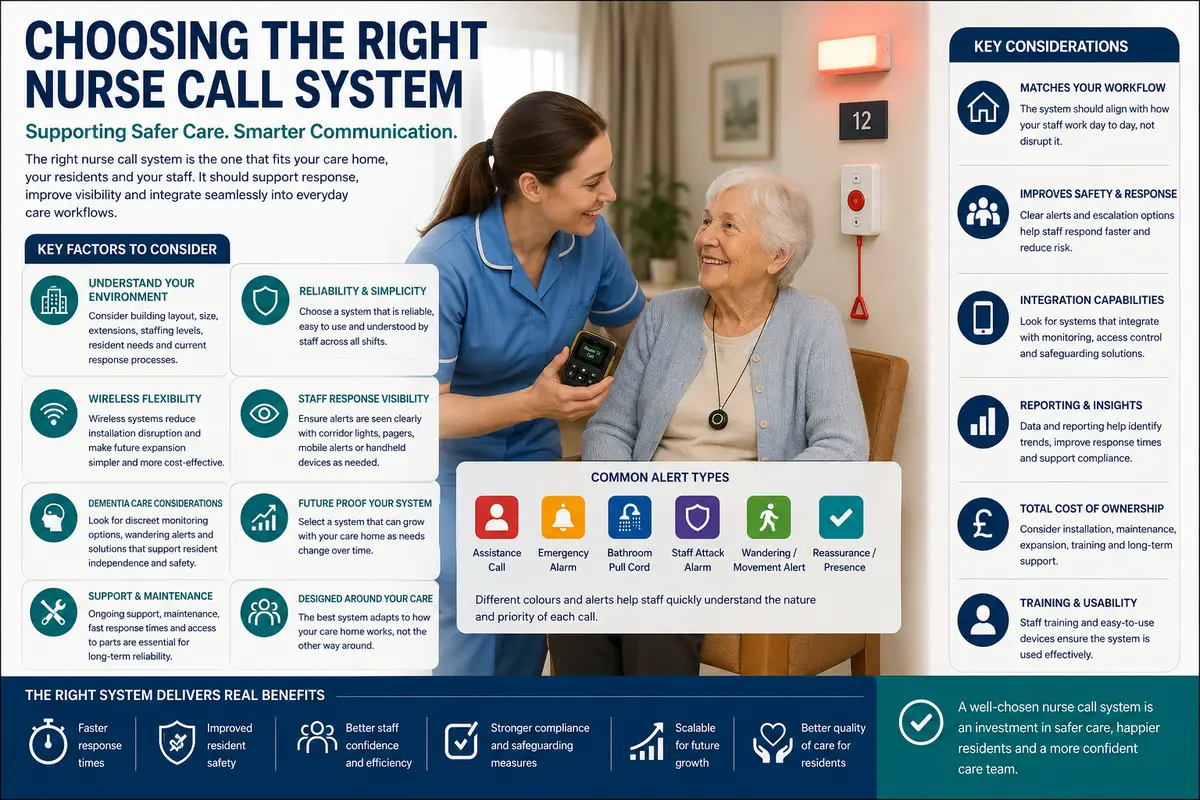
Care home nurse using a wireless nurse call system while assisting an elderly resident with corridor alert lights and communication features visible

Choosing a Nurse Call System for a Care Home

Choosing a nurse call system for a care home is rarely just a technical decision. The system becomes part of the day-to-day operation of the building, influencing how staff respond, how residents request assistance, and how safe communication is managed across different areas of the environment.

In smaller residential settings, requirements may be relatively straightforward. In larger care homes or specialist dementia environments, the system may need to support multiple alert types, staff communication workflows, wandering management, escalation procedures, and integration with other safeguarding measures.

Because of that, the most suitable system is usually the one that reflects how the care home actually operates rather than simply the one with the longest feature list.

The Environment Usually Shapes the System Requirements

No two care homes function in exactly the same way.

An older converted property with narrow corridors, multiple extensions, and varied room layouts presents very different installation challenges from a purpose-built modern care environment. Staffing structures, resident dependency levels, dementia support requirements, and overnight response arrangements also affect what the system needs to achieve operationally.

In some homes, visibility and simplicity may be the priority. In others, management teams may require more detailed reporting, mobile staff alerts, or integrated monitoring devices across multiple floors or wings.

That is why system selection normally starts with understanding the building and operational environment rather than focusing immediately on hardware.

Many providers first review care home nurse call systems based on how the building operates day to day rather than purely on specifications.

Reliability Matters More Than Feature Quantity

Care homes often operate continuously with changing staffing levels, varying resident needs, and periods where response times become especially important. Under those conditions, consistency tends to matter more operationally than complexity.

A system that staff understand clearly and respond to confidently is usually more valuable than one overloaded with features that are rarely used properly in practice.

That does not mean advanced functionality has no role. Many care homes benefit from:

  • Mobile staff alerts
  • Escalation procedures
  • Bed monitoring
  • Movement alerts
  • Reporting software
  • Staff attack alarms

The important question is whether those features improve response management within the home itself rather than simply expanding the specification sheet.

In practice, the strongest systems are usually those that integrate naturally into existing care workflows without unnecessarily complicating everyday operations.

Wireless Systems Are Often Favoured in Occupied Care Environments

Many care homes now favour wireless nurse call systems because they reduce installation disruption and allow greater flexibility over time.

In occupied buildings, large-scale cabling work can be difficult to manage around residents, particularly where rooms remain in continuous use. Wireless infrastructure allows systems to be installed or expanded with significantly less disruption to flooring, ceilings, decoration, and day-to-day care activities.

This becomes particularly useful in:

  • Older buildings
  • Converted properties
  • Phased refurbishments
  • Expanding care environments
  • Homes where room usage changes regularly

Additional devices can usually be introduced more easily later if the resident’s needs evolve or the operational layout changes.

That flexibility is often one of the main operational advantages of wireless systems within care home environments.

Many organisations also compare wireless vs wired nurse call systems when assessing long-term flexibility and installation practicality.

Staff Response Visibility Is a Major Operational Factor

One of the most important aspects of a nurse call system is how clearly alerts are communicated to staff throughout the building.

In smaller homes, corridor lights and local annunciation may be sufficient. In larger homes, staff may rely more heavily on pagers, handheld devices, or mobile alerting because teams are spread across wider areas.

The system needs to support fast recognition of:

  • Where the alert originated
  • What type of alert has been triggered
  • Whether escalation is required
  • Whether assistance has already been acknowledged

This becomes increasingly important overnight when staffing levels are lower and response management needs to remain efficient across multiple resident areas.

In practice, visibility and clarity often matter more than the number of devices installed.

These operational factors directly influence nurse call response times in care environments.

Dementia Care Environments May Require Different Considerations

Care homes supporting residents with dementia or cognitive impairment often place additional demands on nurse call infrastructure.

In these environments, systems may need to support:

  • Wandering alerts
  • Discreet monitoring
  • Door monitoring
  • Wearable alarms
  • Movement detection
  • Staff protection measures

The balance between resident independence and safeguarding also becomes more sensitive operationally. Overly intrusive systems can negatively affect the environment, while insufficient monitoring may increase operational risk.

Because of this, system design in dementia care settings often relies more on day-to-day resident behaviour and staffing workflows than on standardised layouts alone.

Expansion and Long-Term Flexibility Should Not Be Overlooked

Care homes rarely remain operationally static for long periods.

Rooms may be repurposed, extensions may be added, occupancy levels may change, and additional monitoring requirements may emerge gradually over time. A system that works well initially but becomes difficult to expand later can create operational limitations surprisingly quickly.

That is why long-term flexibility matters.

Some providers focus heavily on the installation itself without considering how the system will evolve operationally several years later. In practice, ease of expansion, availability of ongoing support, and future device compatibility are often just as important as the original specification.

This is particularly relevant in care environments where phased upgrades are more realistic than complete infrastructure replacement projects.

These discussions often arise during reviews of upgrading nurse call systems in existing care homes.

Support and Maintenance Are Part of the System Itself

Nurse call systems are part of everyday safeguarding and communication infrastructure within the home. Reliability, therefore, depends not only on installation quality but also on ongoing support and maintenance arrangements.

Devices require testing, batteries require monitoring, and faults need to be resolved quickly without creating unnecessary disruption to resident care.

For many care homes, the responsiveness of technical support becomes one of the most important factors over time. Delays, poor communication, or limited replacement availability can quickly undermine operational confidence when communication systems are relied upon continuously.

That is one reason many care providers prioritise long-term support relationships rather than treating the system purely as a one-off equipment purchase.

Many long-term maintenance discussions also begin after providers encounter operational issues with ageing nurse call systems.

The Best Systems Are Designed Around the Building, Not Imposed Onto It

One of the most common mistakes in nurse call system selection is assuming that every care home should operate the same way.

In reality, buildings, staffing structures, resident needs, and operational pressures vary significantly between environments. The strongest systems are usually the ones designed around those practical realities rather than forcing the environment to adapt around the technology.

That may involve:

  • Simplifying alert visibility
  • Improving staff mobility
  • Reducing installation disruption
  • Supporting phased expansion
  • Improving overnight response management
  • Integrating safeguarding measures more effectively

The objective is not simply to install call points throughout a building. It is to create a communication system that supports safe, efficient, and manageable care delivery every day.