Choosing a Nurse Call System for a Care Home
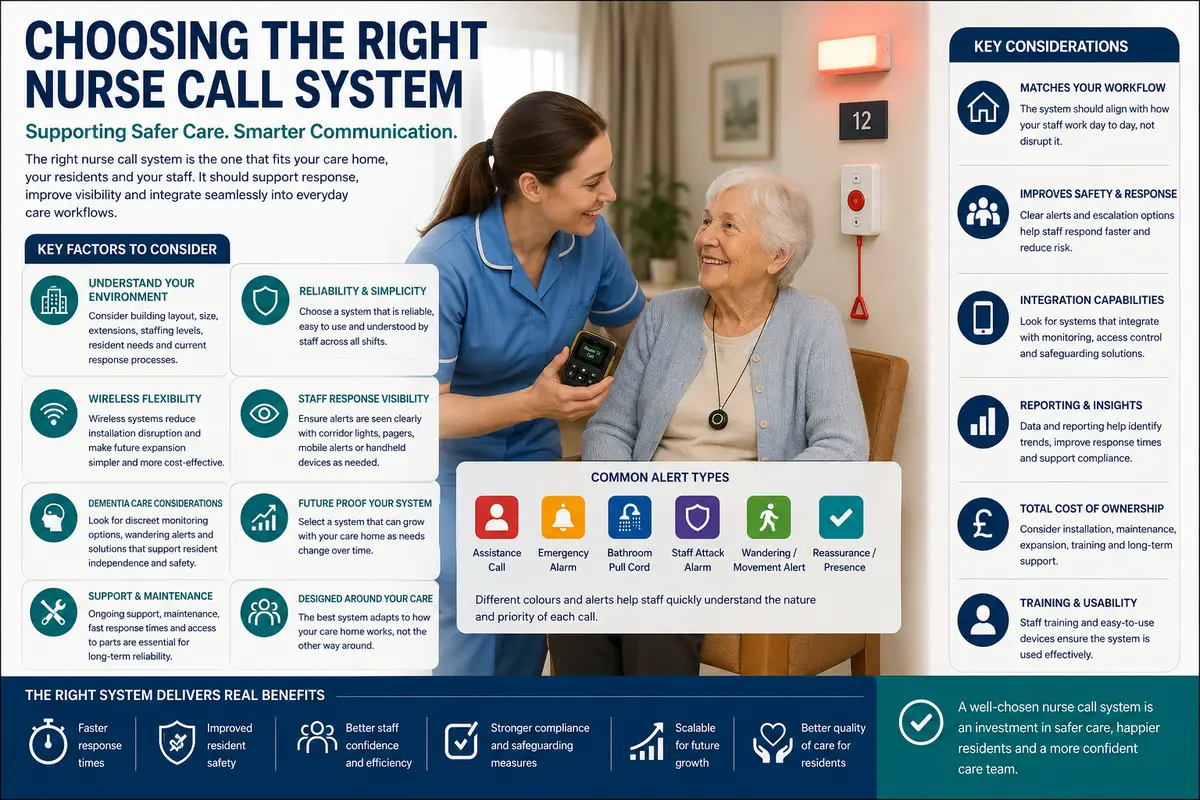
Choosing a nurse call system for a care home is rarely just a technical decision. The system becomes part of the day-to-day operation of the building, influencing how staff respond, how residents request assistance, and how safe communication is managed across different areas of the environment.
In smaller residential settings, requirements may be relatively straightforward. In larger care homes or specialist dementia environments, the system may need to support multiple alert types, staff communication workflows, wandering management, escalation procedures, and integration with other safeguarding measures.
Because of that, the most suitable system is usually the one that reflects how the care home actually operates rather than simply the one with the longest feature list.
The Environment Usually Shapes the System Requirements
No two care homes function in exactly the same way.
An older converted property with narrow corridors, multiple extensions, and varied room layouts presents very different installation challenges from a purpose-built modern care environment. Staffing structures, resident dependency levels, dementia support requirements, and overnight response arrangements also affect what the system needs to achieve operationally.
In some homes, visibility and simplicity may be the priority. In others, management teams may require more detailed reporting, mobile staff alerts, or integrated monitoring devices across multiple floors or wings.
That is why system selection normally starts with understanding the building and operational environment rather than focusing immediately on hardware.
Many providers first review care home nurse call systems based on how the building operates day to day rather than purely on specifications.
Reliability Matters More Than Feature Quantity
Care homes often operate continuously with changing staffing levels, varying resident needs, and periods where response times become especially important. Under those conditions, consistency tends to matter more operationally than complexity.
A system that staff understand clearly and respond to confidently is usually more valuable than one overloaded with features that are rarely used properly in practice.
That does not mean advanced functionality has no role. Many care homes benefit from:
- Mobile staff alerts
- Escalation procedures
- Bed monitoring
- Movement alerts
- Reporting software
- Staff attack alarms
The important question is whether those features improve response management within the home itself rather than simply expanding the specification sheet.
In practice, the strongest systems are usually those that integrate naturally into existing care workflows without unnecessarily complicating everyday operations.
Wireless Systems Are Often Favoured in Occupied Care Environments
Many care homes now favour wireless nurse call systems because they reduce installation disruption and allow greater flexibility over time.
In occupied buildings, large-scale cabling work can be difficult to manage around residents, particularly where rooms remain in continuous use. Wireless infrastructure allows systems to be installed or expanded with significantly less disruption to flooring, ceilings, decoration, and day-to-day care activities.
This becomes particularly useful in:
- Older buildings
- Converted properties
- Phased refurbishments
- Expanding care environments
- Homes where room usage changes regularly
Additional devices can usually be introduced more easily later if the resident’s needs evolve or the operational layout changes.
That flexibility is often one of the main operational advantages of wireless systems within care home environments.
Many organisations also compare wireless vs wired nurse call systems when assessing long-term flexibility and installation practicality.
Staff Response Visibility Is a Major Operational Factor
One of the most important aspects of a nurse call system is how clearly alerts are communicated to staff throughout the building.
In smaller homes, corridor lights and local annunciation may be sufficient. In larger homes, staff may rely more heavily on pagers, handheld devices, or mobile alerting because teams are spread across wider areas.
The system needs to support fast recognition of:
- Where the alert originated
- What type of alert has been triggered
- Whether escalation is required
- Whether assistance has already been acknowledged
This becomes increasingly important overnight when staffing levels are lower and response management needs to remain efficient across multiple resident areas.
In practice, visibility and clarity often matter more than the number of devices installed.
These operational factors directly influence nurse call response times in care environments.
Dementia Care Environments May Require Different Considerations
Care homes supporting residents with dementia or cognitive impairment often place additional demands on nurse call infrastructure.
In these environments, systems may need to support:
- Wandering alerts
- Discreet monitoring
- Door monitoring
- Wearable alarms
- Movement detection
- Staff protection measures
The balance between resident independence and safeguarding also becomes more sensitive operationally. Overly intrusive systems can negatively affect the environment, while insufficient monitoring may increase operational risk.
Because of this, system design in dementia care settings often relies more on day-to-day resident behaviour and staffing workflows than on standardised layouts alone.
Expansion and Long-Term Flexibility Should Not Be Overlooked
Care homes rarely remain operationally static for long periods.
Rooms may be repurposed, extensions may be added, occupancy levels may change, and additional monitoring requirements may emerge gradually over time. A system that works well initially but becomes difficult to expand later can create operational limitations surprisingly quickly.
That is why long-term flexibility matters.
Some providers focus heavily on the installation itself without considering how the system will evolve operationally several years later. In practice, ease of expansion, availability of ongoing support, and future device compatibility are often just as important as the original specification.
This is particularly relevant in care environments where phased upgrades are more realistic than complete infrastructure replacement projects.
These discussions often arise during reviews of upgrading nurse call systems in existing care homes.
Support and Maintenance Are Part of the System Itself
Nurse call systems are part of everyday safeguarding and communication infrastructure within the home. Reliability, therefore, depends not only on installation quality but also on ongoing support and maintenance arrangements.
Devices require testing, batteries require monitoring, and faults need to be resolved quickly without creating unnecessary disruption to resident care.
For many care homes, the responsiveness of technical support becomes one of the most important factors over time. Delays, poor communication, or limited replacement availability can quickly undermine operational confidence when communication systems are relied upon continuously.
That is one reason many care providers prioritise long-term support relationships rather than treating the system purely as a one-off equipment purchase.
Many long-term maintenance discussions also begin after providers encounter operational issues with ageing nurse call systems.
The Best Systems Are Designed Around the Building, Not Imposed Onto It
One of the most common mistakes in nurse call system selection is assuming that every care home should operate the same way.
In reality, buildings, staffing structures, resident needs, and operational pressures vary significantly between environments. The strongest systems are usually the ones designed around those practical realities rather than forcing the environment to adapt around the technology.
That may involve:
- Simplifying alert visibility
- Improving staff mobility
- Reducing installation disruption
- Supporting phased expansion
- Improving overnight response management
- Integrating safeguarding measures more effectively
The objective is not simply to install call points throughout a building. It is to create a communication system that supports safe, efficient, and manageable care delivery every day.