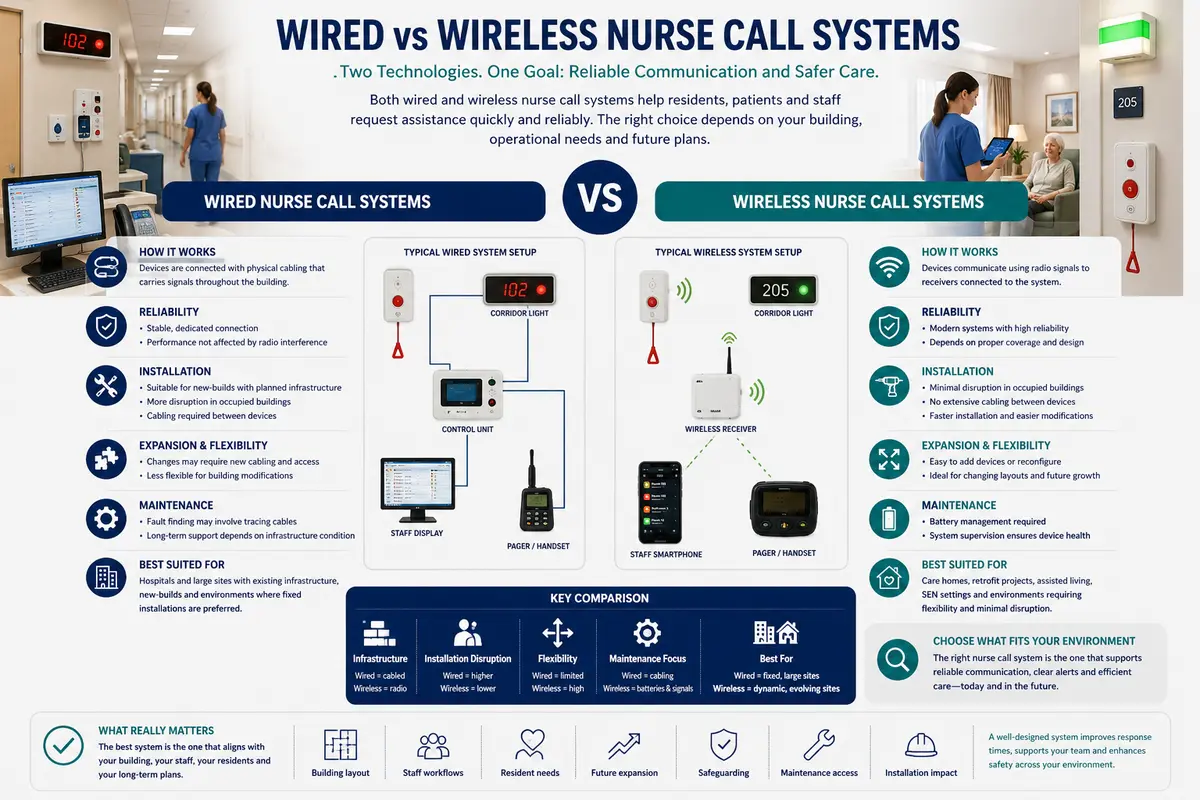
Wireless and wired nurse call systems are both designed to achieve the same core objective: allowing residents, patients, or staff to request assistance quickly and reliably within healthcare and care environments. The difference lies in how those systems communicate throughout the building and how easily the infrastructure can adapt over time.
In practice, the decision between wireless and wired systems is rarely about one technology being universally better than the other. The building itself, the operational environment, installation constraints, and long-term flexibility requirements usually determine which approach is most suitable.
How Traditional Wired Systems Operate
Wired nurse call systems use physical cabling between call points, corridor indicators, control equipment, displays, and staff communication devices. In many hospitals and older healthcare facilities, wired infrastructure has historically been the standard approach because it provides a fixed communication network throughout the site.
In controlled environments where infrastructure is already in place, wired systems can offer long-term stability with clearly defined device locations and fixed installation pathways.
Many larger healthcare sites still operate highly effective wired systems today, particularly where infrastructure has evolved gradually over many years rather than being installed as part of a complete replacement project.
That said, wired infrastructure can become more difficult to adapt as operational requirements change. Expanding into additional rooms, altering layouts, or introducing new devices may require further cabling work, ceiling access, containment adjustments, or temporary disruption within occupied areas.
Why Wireless Systems Have Become More Common
Wireless nurse call systems became increasingly popular as care environments sought to reduce installation disruption while improving flexibility.
In occupied care homes, assisted living environments, SEN settings, and retrofit healthcare buildings, large-scale cabling work is not always practical. Running new wired infrastructure through active resident areas can involve room access, lifting flooring, ceiling work, redecoration, and temporary operational inconvenience, all of which may be difficult to manage safely.
Wireless systems reduce much of that disruption.
Because devices communicate using radio infrastructure rather than direct cabling between every point, installations can often be completed more efficiently while allowing systems to expand more easily later if rooms, workflows, or operational requirements change.
That flexibility has made wireless systems particularly common within:
- Care homes
- Retrofit healthcare environments
- Assisted living schemes
- SEN schools
- Respite facilities
- Temporary healthcare spaces
In many cases, the ability to adapt the system over time becomes just as valuable as the initial installation itself.
This is one reason many providers now review wireless systems in existing care buildings when planning upgrades.
Installation Disruption Is Often a Major Factor
One of the biggest operational differences between wired and wireless systems is the level of disruption associated with installation and future expansion.
In new-build environments where cabling routes are already accessible, wired infrastructure may integrate relatively easily during construction. In occupied buildings, however, installation becomes more complicated.
Care environments rarely stop operating while infrastructure work takes place. Residents still require assistance, staff workflows still need to function normally, and safeguarding considerations remain in place throughout the installation process.
That is one reason wireless systems are frequently favoured in existing care environments. Additional devices, room changes, or system extensions can usually be introduced with significantly less disruption to day-to-day operations.
This becomes particularly important in older buildings where retrofitting new cabling may be structurally difficult or operationally impractical.
Reliability Depends More on System Design Than Technology Alone
There is sometimes an assumption that wired systems are automatically more reliable than wireless systems. In practice, reliability depends far more on the quality of system design, infrastructure planning, installation standards, and ongoing maintenance.
A poorly designed wired system can create operational limitations just as easily as a poorly configured wireless installation can create signal coverage issues.
Wireless systems rely heavily on:
- Correct receiver positioning
- Signal consistency
- Building assessment
- Interference management
- Proper commissioning
Wired systems rely on:
- Cabling integrity
- Infrastructure condition
- Network continuity
- Physical installation quality
- Long-term maintenance access
Both approaches require careful planning if they are expected to operate reliably within demanding healthcare environments.
The operational reality of the site usually matters more than broad assumptions about one technology being inherently superior.
Many organisations only begin identifying operational limitations while reviewing common problems with nurse call systems in ageing environments.
Expansion and Long-Term Flexibility
Long-term flexibility is often where wireless systems become particularly attractive operationally.
Healthcare and care environments rarely remain static for long periods. Rooms may be repurposed, monitoring requirements may change, occupancy levels may shift, and additional safeguarding measures may need to be introduced over time.
In wired systems, these changes can require further infrastructure work to extend cabling routes or reposition fixed devices. Wireless systems generally allow additional devices to be integrated more easily without major structural work.
That does not necessarily make wireless systems simpler overall, but it does often make future adaptation more manageable operationally.
For organisations planning phased upgrades or gradual expansion, that flexibility can become a significant advantage.
These considerations are often discussed during reviews of nurse call system upgrades within existing care environments.
Maintenance Considerations Are Different
Maintenance requirements also differ between wired and wireless systems.
Wired systems often require fault tracing across physical cabling infrastructure, particularly in older installations where documentation may have changed over time. Locating faults can sometimes involve accessing ceilings, wall voids, or legacy infrastructure routes.
Wireless systems remove much of that cabling dependency but introduce other considerations, including:
- Battery monitoring
- Signal supervision
- Device health management
- Receiver coverage verification
Neither approach is maintenance-free.
What matters most is whether the system can be maintained consistently and supported effectively over the long term within the operational demands of the environment.
Some Environments Now Use Hybrid Approaches
In practice, many organisations no longer view the decision as entirely wireless or entirely wired.
Hybrid approaches are increasingly common, particularly within larger healthcare environments where certain infrastructure may remain wired while additional areas, extensions, or specialist monitoring devices are introduced wirelessly.
This allows organisations to expand or modernise systems gradually without replacing all infrastructure simultaneously.
In some environments, that staged approach is operationally more realistic than attempting a complete system replacement in a single project.
Choosing the Right System for the Environment
The most suitable nurse call system is usually the one that best aligns with the building’s operational realities, rather than simply the newest available technology.
A modern care home prioritising flexibility and minimal disruption may favour wireless infrastructure from the outset. A hospital with extensive existing infrastructure may continue to operate highly effective wired systems for many years while gradually introducing wireless capabilities where appropriate.
The important question is not simply whether a system is wired or wireless. It is whether the infrastructure supports reliable communication, clear alert management, safe response procedures, and long-term operational usability within the environment itself.
That assessment normally requires consideration of:
- Building layout
- Installation constraints
- Future expansion plans
- Staffing workflows
- Safeguarding requirements
- Ongoing maintenance access
- Operational disruption during installation
The strongest systems are usually those designed around how the environment functions day to day, rather than around technology labels alone.