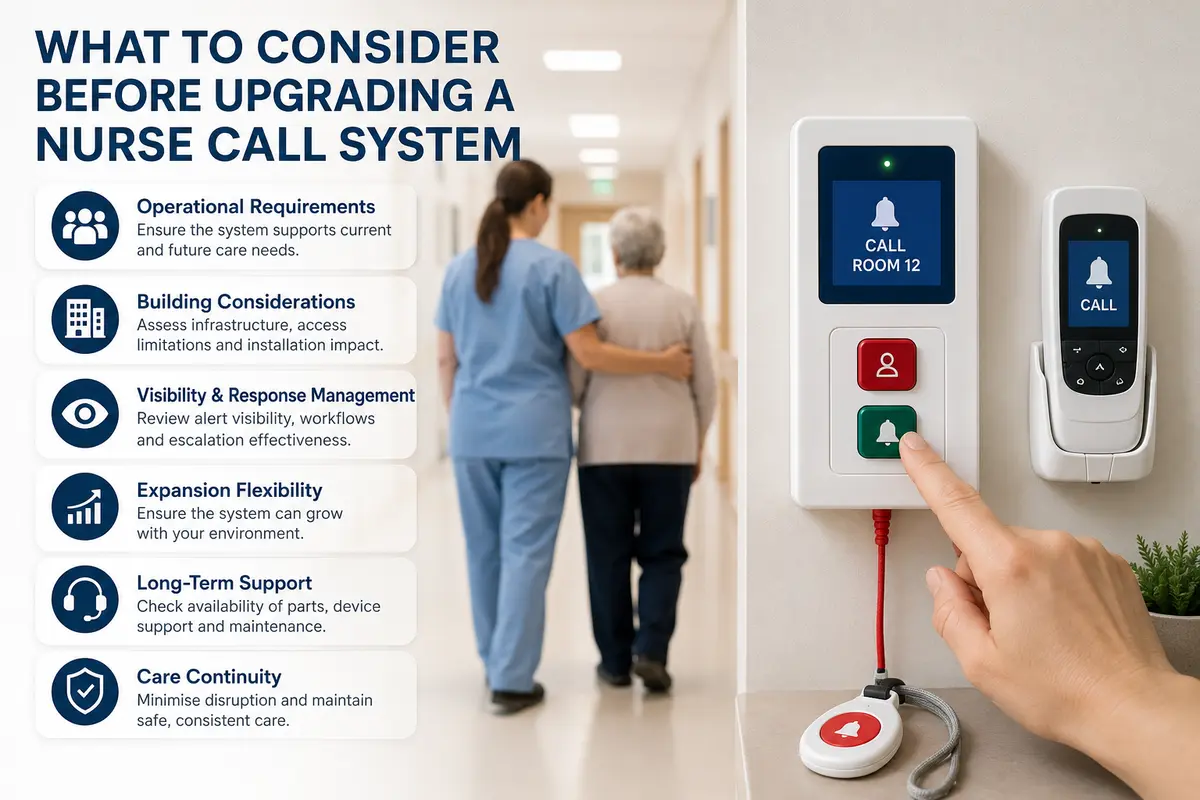
In many care environments, nurse call upgrades are introduced gradually as operational requirements change, rather than because the existing system has stopped functioning entirely. A system may still appear operational day to day, while underlying limitations begin to affect response visibility, maintenance efficiency, expansion flexibility, or long-term reliability across the building.
That is why upgrading a nurse call system is rarely just a technical replacement project. In practice, it usually involves reviewing how the environment currently functions, how communication workflows have evolved over time, and whether the existing infrastructure still effectively supports day-to-day care delivery.
The strongest upgrade projects are normally the ones planned around operational realities, rather than simply replacing equipment like-for-like.
Operational Requirements Often Change Faster Than Infrastructure
Many care homes and healthcare environments evolve gradually over time. Resident dependency levels may increase, staffing structures may change, extensions may be added, and safeguarding requirements may become more complex compared with when the original system was first installed.
In some environments, infrastructure that worked well several years ago may begin to create operational limitations simply because the building and maintenance requirements surrounding it have changed significantly.
This may become noticeable through:
- Inconsistent alert visibility
- Slower response coordination
- Expansion difficulties
- Increasing maintenance requirements
- Limited integration capability
- Ageing devices becoming harder to support
The issue is not always that the system has failed. More commonly, the environment has outgrown the assumptions the original infrastructure was designed around.
Many providers first begin identifying these operational limitations while reviewing common problems with nurse call systems across older environments.
Existing Buildings Often Create Upgrade Challenges
Many care environments operate in buildings that have been repeatedly adapted over time, rather than being purpose-built around modern communication infrastructure.
Older care homes, converted residential properties, phased extensions, and long-established healthcare environments can all create practical limitations when systems need upgrading.
In some buildings, introducing additional cabling may involve:
- Ceiling access
- Flooring work
- Redecoration
- Room disruption
- Temporary operational adjustments
- Restricted installation routes
That is one reason many organisations review wireless infrastructure during upgrade planning, particularly where maintaining day-to-day continuity of care remains a major operational priority.
The practical realities of the building itself usually influence upgrade decisions just as much as the system’s technical specification.
Our guide to wireless systems in existing care buildings explains why retrofit flexibility is often important during phased upgrades.
Visibility And Response Management Should Be Reviewed Carefully
One of the most important parts of any upgrade review is understanding how effectively alerts are currently being recognised and managed throughout the environment.
A system may still activate correctly while operational visibility has become weaker over time because of:
- Staffing movement changes
- Extensions or layout alterations
- Inconsistent corridor visibility
- Growing reliance on mobile communication
- Increased alert activity
- Evolving resident support requirements
In larger environments, especially, response efficiency often depends as much on visibility and workflow alignment as the infrastructure itself.
This is why upgrade assessments should normally focus on:
- How staff move throughout the building
- How alerts are prioritised
- Where visibility limitations occur
- How overnight response differs operationally
- Whether escalation procedures remain effective
rather than simply reviewing hardware age alone.
In many environments, operational visibility also depends heavily on properly configured nurse call corridor lights and clear alert management throughout the building.
Expansion Flexibility Becomes Increasingly Important
Many organisations begin considering upgrades when existing infrastructure becomes difficult to expand.
Additional rooms, monitoring devices, safeguarding measures, or communication requirements may gradually exceed what the original system was designed to support efficiently.
In wired environments, particularly, introducing additional infrastructure later can sometimes become operationally complex if:
- Cabling routes are restricted
- Building layouts have changed
- Documentation is incomplete
- Legacy devices are no longer supported
- Infrastructure has evolved in phases over many years
This does not necessarily mean complete replacement is required immediately. In many environments, phased upgrades or hybrid infrastructure approaches are operationally more realistic than full replacement projects completed all at once.
For organisations assessing future infrastructure flexibility, comparing wireless vs wired nurse call systems can help clarify some of the operational differences between both approaches.
Long-Term Support Availability Matters
One of the less visible issues affecting older nurse call systems is the availability of long-term support.
A system may still operate reliably day to day while:
- Replacement devices become limited
- Batteries become harder to source
- Legacy components are discontinued
- Maintenance response becomes slower
- Integration with newer infrastructure becomes restricted
Over time, this can make fault resolution and future expansion increasingly difficult operationally.
That is why support planning is often just as important as the infrastructure itself during upgrade discussions.
For many organisations, the question is not only whether the system works today, but also whether it can be reliably maintained and adapted for several years into the future.
Care Continuity Usually Shapes The Upgrade Approach
Unlike many commercial environments, care homes and healthcare settings cannot simply pause normal operations while infrastructure is replaced.
Residents still require assistance, staff workflows must continue functioning safely, and safeguarding responsibilities remain fully active throughout installation work.
Because of this, upgrade planning often focuses heavily on:
- Phased installation
- Minimising disruption
- Maintaining alert coverage throughout works
- Preserving overnight operational visibility
- Avoiding unnecessary resident disturbance
This is particularly important in:
- Dementia care environments
- High-dependency settings
- Occupied healthcare buildings
- Environments with vulnerable residents
- Multi-wing care facilities
The operational continuity of the environment usually becomes one of the most important factors shaping how upgrades are delivered.
Wireless Infrastructure Is Often Reviewed During Upgrades
Many organisations reviewing older systems now consider whether wireless infrastructure may provide greater long-term flexibility within the environment.
This is not simply because wireless systems reduce cabling. More often, it is because they can make future adaptation easier operationally as buildings and care requirements continue evolving over time.
In existing care environments, wireless systems may help reduce:
- Installation disruption
- Structural alteration
- Phased expansion difficulty
- Future device relocation complexity
while still allowing the communication infrastructure to expand alongside operational changes within the building.
The suitability of wireless infrastructure still depends heavily on proper site assessment, signal planning, and operational design rather than the technology alone.
Upgrades Should Reflect How The Environment Functions
One of the most common mistakes during nurse call upgrades is assuming the replacement system should mirror the previous installation exactly.
In practice, environments often function very differently compared with when the original infrastructure was first introduced. Staffing workflows, resident needs, safeguarding priorities, and building layouts may all have evolved significantly over time.
The strongest upgrade projects usually begin by asking:
- How staff communicate today
- Where visibility limitations currently exist
- How residents request assistance
- What operational pressures have changed
- How future expansion is likely to develop
- Where response coordination can be improved
rather than simply replacing hardware room by room.
Many organisations also review care home nurse call systems differently once staffing workflows and safeguarding priorities have evolved over time.
The Objective Is Long-Term Operational Suitability
At its core, a nurse call system exists to support safe and manageable communication throughout the environment. Upgrading that infrastructure is therefore not only about introducing newer equipment. It is about ensuring the system continues to support the building’s operational reality as care delivery requirements evolve over time.
For some environments, that may involve phased wireless expansion. For others, it may involve improving visibility, simplifying workflows, integrating additional safeguarding measures, or resolving long-standing infrastructure limitations.
The most effective upgrades are usually the ones designed around how the environment operates day to day, rather than technology alone.