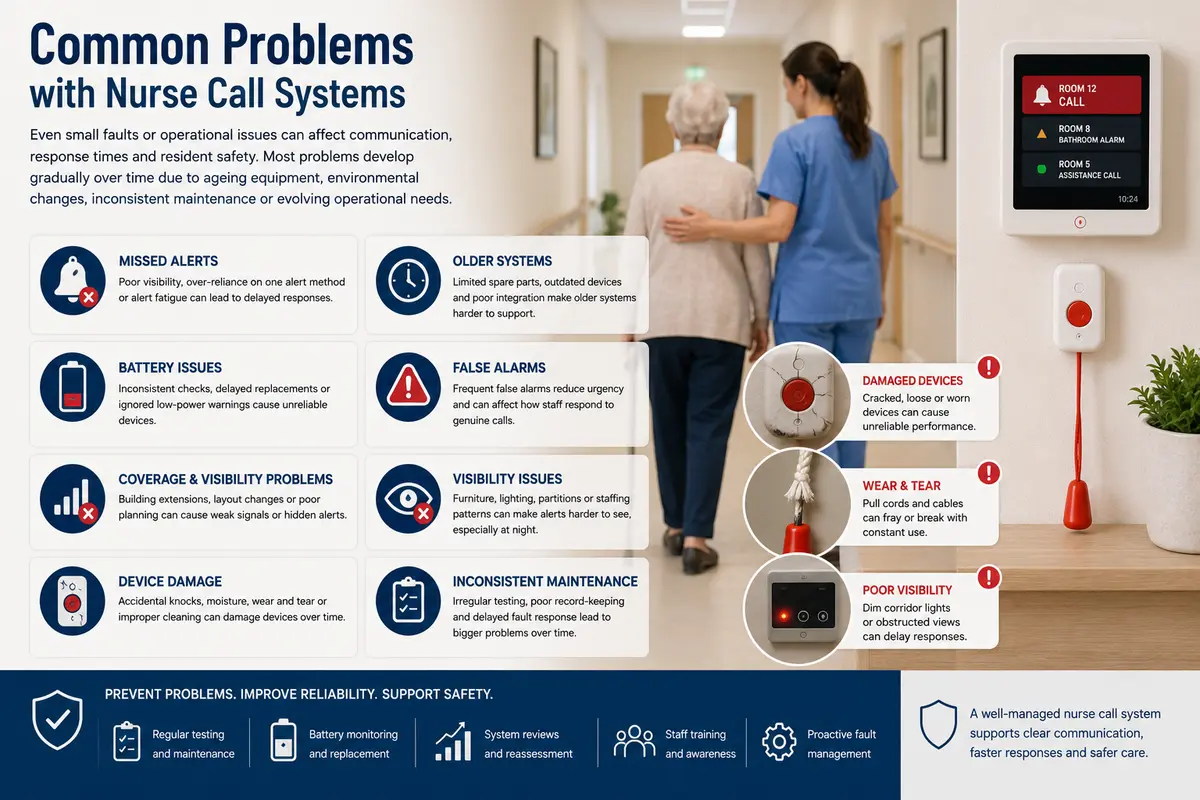
Nurse call systems are expected to operate continuously in environments where communication, response times, and resident safety are integral to everyday care delivery. Because of that, even relatively small faults or operational issues can become significant surprisingly quickly if they are left unresolved.
In practice, most nurse call problems are not caused by complete system failure. More commonly, issues develop gradually over time due to ageing infrastructure, inconsistent maintenance, environmental changes, or systems that no longer meet the building’s operational demands.
Understanding where those problems typically arise is often more useful than simply focusing on the technology itself.
Missed Alerts Are Usually an Operational Issue Before a Technical One
One of the most serious concerns within any nurse call environment is the possibility of alerts being missed or responded to late.
In some cases, this may be caused by equipment faults, signal issues, or damaged devices. More often, however, missed alerts occur because the system no longer aligns with how staff actually work in the building.
For example, a corridor light positioned poorly in an extended wing may reduce visibility during overnight staffing. In larger homes, staff may rely heavily on pagers or mobile alerts, while visual indicators become less effective in practice. In other environments, frequent low-priority alerts can gradually create desensitisation, so urgent calls no longer stand out clearly during busy periods.
The system itself may still be technically operational, but response visibility becomes weaker in practice.
That distinction matters.
Battery Management Is Often Overlooked
Wireless nurse call systems rely heavily on battery-powered devices throughout the building. Pendant alarms, call points, pull cords, wearable devices, and monitoring equipment all require ongoing battery monitoring if the system is expected to remain reliable in the long term.
Most modern systems include battery monitoring and low-power warnings, but problems can still emerge where:
- Testing schedules are inconsistent
- Replacement cycles are delayed
- Devices remain in service beyond expected lifespan
- Battery warnings are ignored during busy periods
In some environments, battery issues develop gradually enough that they are only identified once devices begin behaving inconsistently or failing intermittently.
Good maintenance procedures usually prevent most of these problems before they affect day-to-day operation significantly.
Expansion Sometimes Creates Coverage or Visibility Problems
Many care environments evolve gradually over time. Rooms are repurposed, extensions are added, layouts change, and additional monitoring devices are introduced as operational requirements develop.
If those changes are not reflected properly within the nurse call infrastructure, systems can become uneven operationally. New areas may have weaker signal coverage, alert visibility may become inconsistent, or staff workflows may shift in ways the original system design never anticipated.
This is particularly common in:
- Older buildings
- Phased refurbishments
- Converted properties
- Environments with multiple extensions
- Sites that have expanded gradually over many years
The original system may still function well technically, but the operational environment surrounding it has changed considerably.
That is why periodic reassessment is often just as important as routine maintenance.
Many providers encounter these operational pressures when reviewing older nurse call systems during upgrade planning.
Device Damage Is Common in Busy Care Environments
Nurse call devices operate within environments where equipment is used continuously throughout the day and night. Pull cords, pendants, call buttons, corridor indicators, and personal alarms all experience ongoing physical use within high-traffic areas.
Over time, devices can become damaged through:
- Accidental knocks
- Improper cleaning
- Moisture exposure
- Wear and tear
- Repeated impact
- Battery compartment damage
- Cable strain on older infrastructure
In some cases, the damage is obvious immediately. In others, devices continue to operate intermittently, creating unreliable behaviour that becomes increasingly difficult to identify consistently.
Routine testing helps reduce the likelihood of these issues developing unnoticed.
Older Systems Can Become Difficult to Support
Some nurse call systems remain operational for many years, particularly in healthcare environments where infrastructure replacement is phased gradually rather than completed all at once.
The challenge is not always whether the system still works. More commonly, support becomes more complicated as:
- Replacement parts become limited
- Older devices are discontinued
- Documentation becomes outdated
- Expansion capability becomes restricted
- Integration with newer infrastructure becomes difficult
Older wired systems may also become harder to maintain where cabling routes are no longer clearly documented or where building alterations have affected access to infrastructure over time.
This does not necessarily mean older systems require immediate replacement, but it does increase the importance of long-term support planning.
Many environments eventually begin comparing wireless vs wired nurse call systems once older infrastructure becomes harder to maintain operationally.
False Alarms Can Affect Response Behaviour
Frequent false alarms are often treated as a minor inconvenience initially, but over time, they can affect how staff respond to alerts operationally.
If certain devices trigger repeatedly without genuine assistance being required, staff may begin anticipating non-urgent activations before reaching the room itself. In busy environments, that shift in expectation can gradually reduce urgency and affect response consistency.
False alarms may develop because of:
- Damaged call devices
- Environmental interference
- Inappropriate device placement
- Accidental activation
- Incorrect configuration
- Worn components
The underlying cause is not always technical failure alone. In some environments, system configuration simply no longer reflects how rooms or equipment are being used operationally.
Visibility Issues Often Emerge Gradually
Visual alerting remains one of the most important aspects of nurse call infrastructure, particularly in care homes and other large residential environments.
As buildings evolve over time, however, visibility problems sometimes emerge gradually without being recognised immediately. Furniture changes, lighting adjustments, partitioning, extensions, or revised staffing patterns can all affect how clearly alerts are identified throughout the building.
This becomes especially important:
- Overnight
- During reduced staffing periods
- In larger wings
- Around corners or split-level layouts
- Within dementia care environments
A system may still trigger alerts correctly while operational visibility becomes progressively weaker.
That is one reason system reviews should focus on how the environment functions day-to-day rather than simply on whether devices technically activate.
Many of these operational concerns directly affect nurse call response times in care environments.
Maintenance Consistency Usually Determines Long-Term Reliability
Most serious nurse call problems do not appear suddenly. More often, they develop gradually, where maintenance, testing, or operational review becomes inconsistent over time.
Healthcare and care environments place constant demands on the communication infrastructure. Devices are used continuously, staffing patterns evolve, operational layouts change, and safeguarding requirements become more complex as environments adapt.
Long-term reliability, therefore, depends heavily on:
- Routine testing
- Battery management
- Fault response
- Operational reassessment
- Infrastructure support
- Staff familiarity with the system
The strongest nurse call systems are usually the ones that continue to evolve alongside the environment itself rather than remain static as operational demands change around them.
The System Should Support the Way the Environment Actually Works
One of the most common causes of operational frustration is not an outright system failure but a gradual mismatch between the infrastructure and the building’s day-to-day reality.
A nurse call system that suited the environment perfectly five years ago may no longer align with:
- Staffing structures
- Resident dependency levels
- Building layouts
- Safeguarding measures
- Response workflows
- Operational priorities
That is why reviewing how the system functions operationally is often just as important as addressing individual technical faults.
In practice, the most reliable environments are usually not the ones with the most complicated systems. They are environments where communication infrastructure, staff workflows, visibility, and maintenance continue to work together consistently as building and care requirements evolve over time.