Corridor lights are among the simplest yet most operationally important components of a nurse call system. In busy care environments, staff often identify active alerts visually before they check a display panel, handheld device, or pager notification.
For that reason, corridor lights are not simply an accessory added onto a system. In many care homes and healthcare environments, they form part of the day-to-day visibility that helps staff quickly and clearly recognise where assistance is required.
Their importance often becomes even more obvious during busy periods, overnight staffing conditions, or in larger environments where staff movement is spread across multiple corridors or floors.
How Corridor Lights Work Within a Nurse Call System
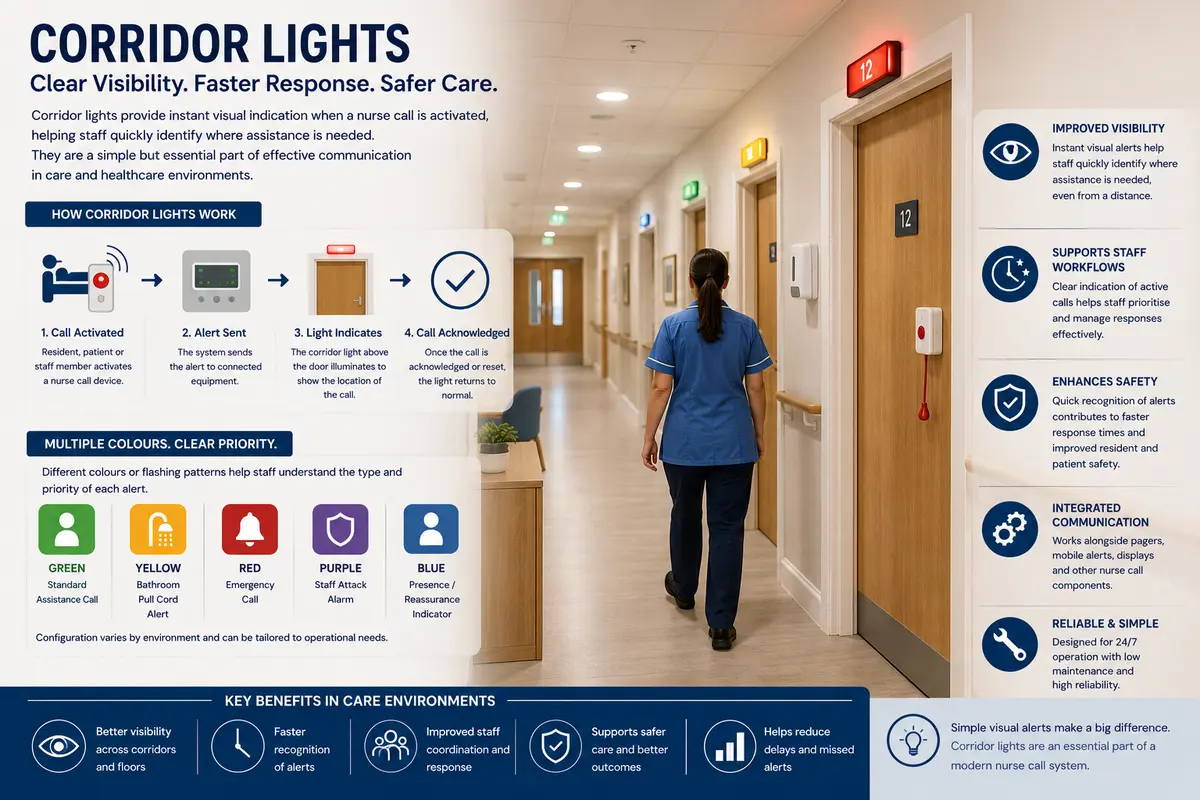
When a resident, patient, or staff member activates a nurse call device, the system sends an alert to connected notification equipment throughout the building. Corridor lights provide a visual indication that a call has been triggered and usually identify the room or area requiring assistance.
In many environments, the corridor light sits above the bedroom, bathroom, or doorway connected to the active call point. Once the call is acknowledged or reset, the light returns to its normal state.
The principle itself is straightforward. What matters operationally is how clearly those alerts can be identified within the working environment.
In care settings where staff may already be moving between rooms, supporting residents, or handling multiple tasks simultaneously, quick visual recognition often considerably improves response efficiency.
This forms an important part of wider nurse call response management throughout busy care environments.
Different Light Colours Often Indicate Different Alert Types
Many modern nurse call systems use multiple colours or flashing sequences to help staff identify the nature or priority of the alert.
For example, systems may differentiate between:
- Standard assistance calls
- Emergency alarms
- Bathroom pull cord alerts
- Staff attack alarms
- Presence indication
- Reassurance or reset functions
The exact configuration varies depending on the environment and the site’s operational requirements.
In some care homes, keeping the system simple and highly visible is more important than introducing multiple complex alert states. In larger healthcare environments, however, more advanced visual differentiation may help staff prioritise response more effectively across multiple areas.
The most effective setup is usually the one that staff can recognise quickly and consistently under normal working conditions.
Visibility Matters More Than People Sometimes Expect
The positioning and visibility of corridor lights can directly affect how effectively alerts are recognised throughout the building.
In older care homes or converted properties, corridor layouts are not always straightforward. Corners, extensions, split-level layouts, narrow hallways, and inconsistent lighting conditions can all affect how easily alerts are seen during normal operation.
That is why corridor lights are normally considered as part of the wider system design rather than added purely as a finishing detail.
In practice, visibility often matters most:
- During overnight staffing
- In dementia care environments
- During periods of reduced staffing levels
- In larger homes with multiple wings
- Where staff are frequently mobile rather than desk-based
A well-positioned visual alert system can reduce delays in identifying calls, particularly when staff are already working elsewhere within the building.
Many providers first begin reviewing visibility concerns while assessing common problems with nurse call systems in older environments.
Corridor Lights Also Support Reassurance and Workflow Visibility
Beyond emergency response, corridor lights often help staff manage everyday workflow throughout the home.
Presence indicators, reassurance functions, and staff attendance notifications can all contribute to clearer visibility regarding which rooms are currently being attended to and which calls still require response.
In some environments, this helps avoid duplication where multiple staff unknowingly respond to the same call while other alerts remain unattended elsewhere.
Simple visual status indication can therefore improve operational flow without introducing unnecessary complexity into the system itself.
Dementia Care Environments May Require Additional Consideration
In dementia care settings, visual alert systems sometimes need to be balanced carefully against the wider environment.
Highly intrusive flashing systems may increase agitation or confusion for some residents, while insufficient visibility may reduce staff awareness during busy periods. Because of this, corridor light configuration often becomes more dependent on the operational realities of the home itself rather than simply following a standard layout approach.
In specialist environments, systems may need to support:
- Discreet alert visibility
- Zoning
- Silent alert escalation
- Staff-only notification arrangements
- Integration with monitoring devices
The objective is usually to maintain clear staff communication while preserving a calm and manageable resident environment wherever possible.
Integration with Wider Nurse Call Infrastructure
Corridor lights rarely operate in isolation. In most installations, they form part of a wider nurse call infrastructure that may also include:
- Annunciator panels
- Pagers
- Mobile staff alerts
- Display screens
- Emergency alarms
- Door monitoring systems
- Staff attack alarms
This layered approach allows alerts to remain visible through multiple communication methods simultaneously.
In practice, visual indication often serves as one component of a broader response system rather than the sole method for alert management.
That redundancy can become particularly important during busy operational periods where staff attention is divided across multiple tasks and environments.
Many organisations integrate corridor indication alongside wireless nurse call systems to maintain clearer building-wide visibility.
Maintenance and Reliability Considerations
Like all nurse call components, corridor lights require ongoing maintenance and testing to ensure they remain fully operational.
A failed visual indicator may appear relatively minor initially, but in practice it can reduce response visibility considerably within certain areas of the building.
Routine testing usually forms part of wider nurse call maintenance procedures and may include:
- Light functionality checks
- Colour sequence verification
- Connection testing
- Alert integration checks
- Visibility assessment
In larger or older environments, maintaining consistency across multiple areas of the site is often just as important as the functionality of individual devices themselves.
Many providers also review corridor indication during wider discussions around upgrading nurse call systems in ageing buildings.
Simple Visibility Often Improves Response Management
Modern nurse call systems may involve software integration, mobile alerts, escalation logic, and reporting capabilities, but visual alerting remains one of the most effective communication methods in many care environments.
Staff working in busy healthcare settings often rely on immediate environmental awareness as much as digital notifications. Corridor lights maintain that awareness throughout the building without requiring staff to stop, check a screen, or constantly monitor a handheld device.
That simplicity is part of why corridor lights remain widely used in modern nurse call infrastructure.
In many environments, the most effective systems are not necessarily the most complicated. They are the systems that enable staff to clearly recognise, prioritise, and respond to assistance requests in everyday working conditions.