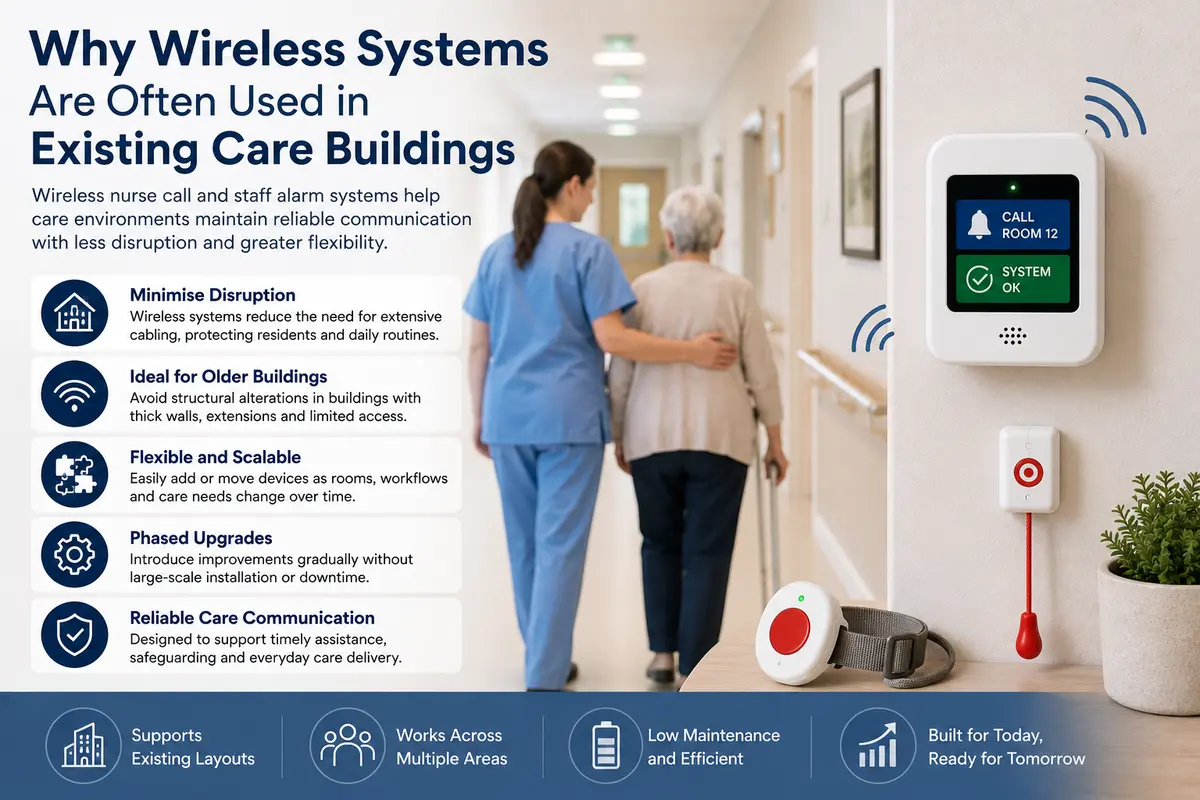
In many existing care homes and healthcare environments, installing new infrastructure is rarely as straightforward as it first appears. Buildings may have been gradually extended over time, converted from older properties, or repeatedly adapted as residents’ requirements and operational demands have changed.
Under those conditions, introducing new cabling throughout occupied areas can create practical and operational disruptions that are difficult to manage amid day-to-day care delivery. That is one of the main reasons wireless nurse call systems for care homes and staff alarm systems are now widely used across existing care environments.
The decision is not usually about avoiding cabling purely for convenience. More often, it is about maintaining operational continuity while introducing a communication infrastructure that can adapt more easily to the realities of the building itself.
Existing Care Environments Are Rarely Static
Many care homes evolve gradually rather than remain operationally fixed for long periods.
Rooms may be repurposed, extensions added, communal spaces reconfigured, and resident dependency levels altered over time. Older properties may also contain a mixture of original construction methods, later refurbishments, and phased upgrades completed across different decades.
That creates practical challenges when introducing new wired infrastructure.
In some environments, accessing ceiling voids or routing cabling through occupied areas may involve:
- Temporary room access
- Disruption to residents
- Flooring work
- Redecoration
- Phased closures
- Operational adjustments during installation
In active care environments, those practical considerations matter just as much as the system’s technical specifications.
Minimising Disruption Is Often A Major Operational Priority
Care homes and healthcare environments continue operating throughout installation work. Residents still require support, staff workflows must function normally, and safeguarding responsibilities remain in place regardless of infrastructure projects underway in the background.
Because of this, many organisations prioritise systems that can be installed with reduced disruption to:
- Bedrooms
- Communal areas
- Circulation routes
- Staffing routines
- Overnight care arrangements
Wireless systems often allow devices to be introduced or repositioned without extensive structural work throughout the building. In practical terms, this usually makes phased installation and future expansion easier to manage operationally.
That flexibility can be particularly valuable in occupied buildings, where maintaining a calm and stable environment remains important throughout upgrade work.
Older Buildings Can Create Infrastructure Limitations
Many care environments operate within buildings that were never originally designed around modern communication infrastructure.
Converted residential properties, listed buildings, older hospitals, and adapted care facilities can all present structural limitations when additional cabling is required later. Thick walls, inaccessible voids, narrow service routes, and multiple building extensions can make large-scale infrastructure work increasingly complex.
Wireless systems do not remove the need for careful planning, but they often reduce the amount of physical alteration required within the building itself.
That becomes especially useful where preserving the existing environment is operationally or structurally critical.
In some older environments, avoiding unnecessary building disruption may also reduce:
- Project timescales
- Refurbishment costs
- Resident disturbance
- Operational downtime during installation
Flexibility Matters As Care Environments Change
One of the biggest operational advantages of wireless systems is the ability to adapt infrastructure more easily as the environment evolves.
Care settings rarely remain identical over time. Rooms may require additional monitoring devices, staffing workflows may change, and safeguarding measures may become more complex as resident needs develop.
With wired infrastructure, introducing additional devices later may require additional cabling routes, structural access, or partial reinstallation. Wireless systems generally allow additional devices to be integrated more flexibly without large-scale disruption across the wider building.
This is one reason wireless infrastructure is commonly used within:
- Phased refurbishments
- Expanding care homes
- Assisted living environments
- Temporary healthcare spaces
- Buildings with changing room usage
The system can evolve alongside the environment rather than requiring major infrastructure redesign each time operational requirements shift.
Wireless Systems Still Require Careful Design
Although wireless infrastructure reduces physical cabling requirements, reliability still depends heavily on system design and building assessment.
Older buildings can create signal challenges just as easily as they create cabling difficulties. Construction materials, building layout, extensions, lift shafts, plant areas, and multiple floor levels can all affect wireless communication if systems are not planned properly.
That is why proper site assessment remains essential.
The strongest installations usually focus on:
- Signal consistency
- Receiver positioning
- Alert visibility
- Operational workflows
- Long-term maintenance access
- Future expansion capability
rather than simply placing devices wherever physical installation is easiest.
In practice, wireless systems perform most effectively when they are designed around how the environment functions day to day.
For organisations comparing infrastructure approaches, our guide to wireless vs wired nurse call systems explains some of the operational differences between both environments.
Phased Upgrades Are Often More Realistic Operationally
In many healthcare and care environments, replacing all communication infrastructure simultaneously is not always operationally practical.
Budgets, occupancy levels, refurbishment schedules, and staffing pressures often mean improvements occur gradually over time rather than through a single redevelopment project.
Wireless systems can more easily support this phased approach in many cases. Additional areas, devices, or monitoring functions can often be introduced incrementally without requiring full building shutdowns or large-scale infrastructure replacement from the outset.
That staged flexibility is particularly useful in environments where maintaining continuity of care remains the overriding operational priority throughout upgrade work.
Many providers reviewing older infrastructure also begin reassessing what to consider before upgrading a nurse call system as operational requirements evolve over time.
The Environment Usually Determines The Right Solution
Wireless systems are not automatically the correct solution for every building. Some healthcare environments continue to operate highly effective wired infrastructure, particularly where cabling already exists, and operational requirements remain relatively stable.
In many existing care buildings, however, wireless infrastructure provides a balance between:
- Operational flexibility
- Reduced installation disruption
- Future adaptability
- Phased expansion
- Practical retrofit suitability
without requiring extensive structural alteration throughout occupied environments.
The decision usually comes down to how the building functions operationally rather than whether one technology is universally better than the other.
Communication Infrastructure Needs To Support Everyday Care Delivery
At its core, a nurse call or staff alarm system is designed to support communication in environments where residents, patients, and staff rely on timely assistance and clear visibility throughout the day.
In existing care buildings, introducing or upgrading that infrastructure must be carefully balanced against the realities of the environment itself. Installation disruption, resident well-being, operational continuity, future expansion, and long-term maintenance all factor into the decision-making process.
That is why wireless systems are often favoured within existing care environments. Not because they avoid complexity entirely, but because they can make communication infrastructure easier to adapt around the practical realities of occupied buildings over time.